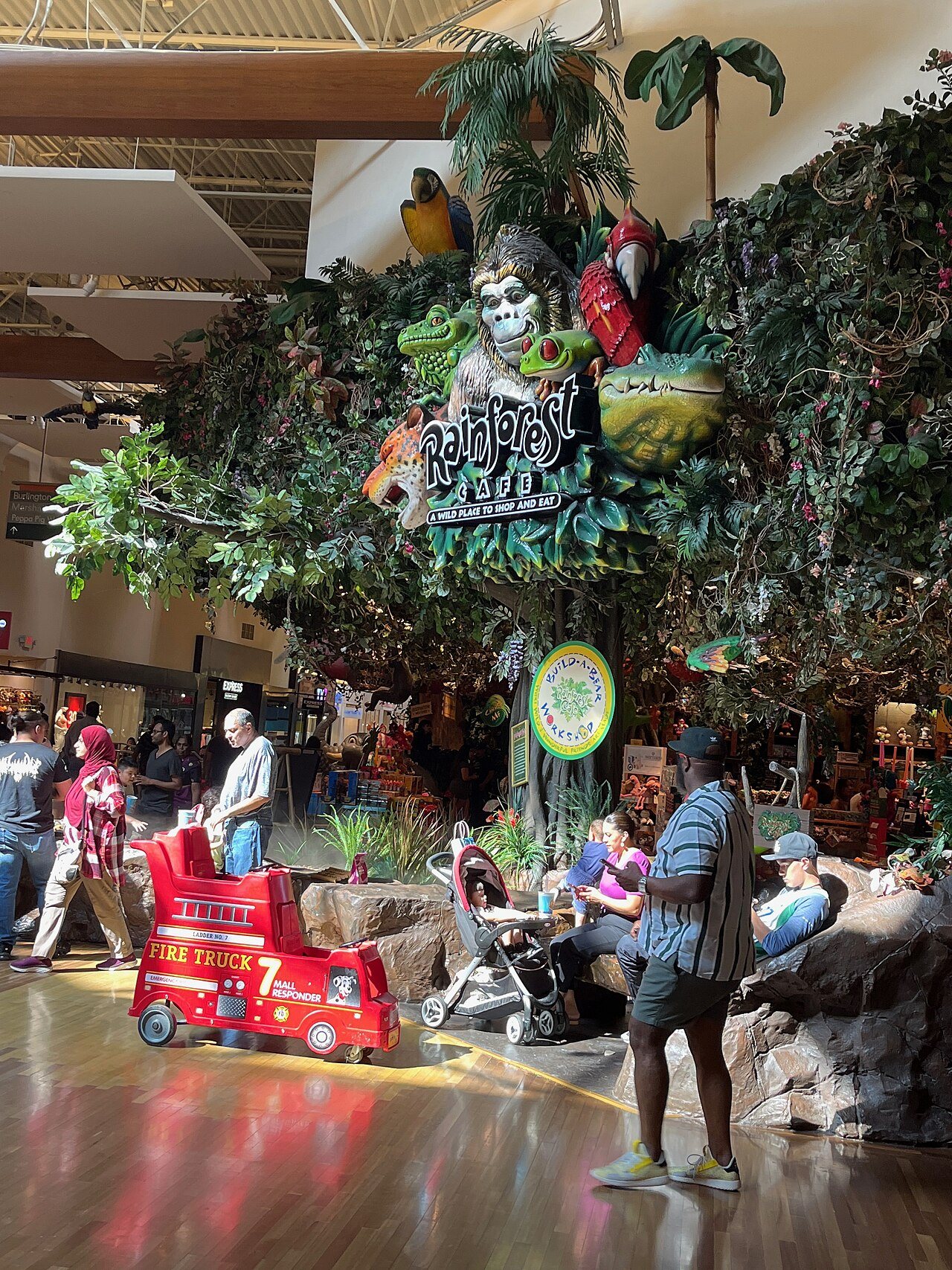
Is Rainforest Cafe still in business in 2026?
Yes. Rainforest Cafe runs 16 restaurants in the United States in 2026, across 11 states, with a handful more in Canada, Japan, France, Malta and the United Arab Emirates. Chowhound put the American count at 16 in 11 states, and that is the figure every other outlet has worked from since.
Texas and Florida have more than one. Most of the other states have exactly one. New Jersey is down to a single restaurant, on the Atlantic City boardwalk, after the Menlo Park Mall location in Edison served its last tables at the end of business on February 19, 2025. Landry's told New Jersey outlets the landlord had declined to renew the lease; Simon Property Group handed the space to Round1 Bowling and Arcade, which opened there in 2026.
The next one to go is abroad. Disneyland Paris has confirmed that the Rainforest Cafe in Disney Village, open since 1999, will close permanently by the end of 2026 as part of the Village's redevelopment. A September 15 date circulated among staff in May 2026 and slipped; Disneyland Paris has never published a final service date, and by autumn part of the gift shop had been emptied and turned into stroller parking.
Who owns Rainforest Cafe today?
Landry's does, and Landry's belongs to Tilman Fertitta. The Houston group took control through a subsidiary called LSR Acquisition Corp., paying $3.25 a share in cash for a company with about 22.9 million shares outstanding, which valued the deal at roughly $75 million.
The offer expired at midnight on October 27, 2000. Around 13,360,000 shares were tendered, and with the 1,030,800 Landry's already held that came to almost 65 percent of the company. Landry's said so plainly in the press release filed with the Securities and Exchange Commission that day: "Since a majority of the shares have been tendered, Landry's will control Rainforest effective today at midnight."
Getting there took two attempts. An earlier and higher 2000 bid was blocked by the State of Wisconsin Investment Board, which held more than 13 percent of Rainforest Cafe and judged the price too low. U.S. Bancorp Piper Jaffray signed the fairness opinion on the $3.25 figure, and a Delaware court later found after trial that $3.25 was indeed the fair value of each share. Fertitta took Landry's private in 2010, and Rainforest Cafe now sits inside Fertitta Entertainment alongside Bubba Gump Shrimp Co. and Morton's The Steakhouse.
How did a house full of birds become a restaurant chain?
Steven Schussler was an advertising salesman, not a restaurateur. In 1989 he started turning his own house in St. Louis Park, Minnesota, into a working prototype of a jungle restaurant, and he kept living in it while he did.
Fortune described the result in 1996: "Artificial waterfalls tumbled down custom-made rock formations, animatronic crocodiles bobbed their heads, and speakers piped in the roar of a tropical thunderstorm."
The animals were real. In his memoir It's a Jungle In There, Schussler listed "Forty tropical birds, two 150-pound tortoises, a baboon, an iguana and a bevy of tropical fish housed in ten 300-gallon fish tanks." Running the demonstration took 3,700 extension cords feeding 20 separate sound, lighting and fog systems, and the electricity bills and the Drug Enforcement Administration both came calling before any investor did.
Then one did. Lyle Berman, the Minneapolis executive behind Grand Casinos, visited the house and put in $1.2 million. Rainforest Cafe, Inc. was incorporated in 1994, the first restaurant opened at the Mall of America in Bloomington, Minnesota, in October 1994, and Schussler became executive vice president for development.
How big did the chain get after the 1995 IPO?
Rainforest Cafe went public on the Nasdaq National Market in April 1995 under the ticker RAIN. The stock was offered at $6 a share, each with a warrant attached. The offering raised $9.5 million, and the warrants brought in another $14.2 million.
The money went straight into construction. Revenue rose from $13.45 million in 1995 to $262.69 million in 1999, close to twentyfold in four years, and the chain topped out at 59 restaurants.
Almost all of them went into American regional shopping malls, which in 1996 looked like the safest real estate in the country. A Rainforest Cafe shared a roof with a Sam Goody record store and a Toys R Us, and depended on the same Saturday crowd all three were built for. Nothing in the rooms came off a shelf either: every waterfall, every fiberglass banyan trunk and every animatronic gorilla was made to order, which made each restaurant expensive to build and impossible to move.
Why did the jungle stop making money?
The first crack showed on January 7, 1998. Rainforest Cafe warned that fourth-quarter earnings would come in around 23 to 24 cents a share against the 25 cents analysts expected, and by mid-afternoon the shares had plunged 12 and three eighths to 18 and three eighths, roughly 40 percent in a day. Morgan Stanley cut the stock to neutral.
Shareholders went to court. A consolidated securities class action was filed in Minnesota on July 31, 1998 on behalf of buyers between October 20, 1997 and January 6, 1998, and was dismissed without prejudice that December; a separate derivative suit against directors and officers had been filed on February 10, 1998. By the time Lakes Gaming agreed a $108 million deal for the chain in December 1999, the stock was down about 75 percent from its early-1998 level.
The underlying problem was the format. A themed restaurant sells a first visit brilliantly and a fifth visit badly, and the malls were emptying. In the second quarter of 2000 the company took "a $98.8 million charge in the second quarter of 2000 relating to the impairment of long-lived assets of 22 mall units," as its own quarterly filing put it. Landry's arrived four months later and pointed the survivors at tourists instead: Disney property, Las Vegas, Niagara Falls, Galveston, Times Square.
Why is Rainforest Cafe popular online again?
Because the children who were taken there in 1998 are adults with phones. On April 1, 2024 the Empire State Building posted a joke announcing a Rainforest Cafe on its observatory, the post went far beyond its usual reach, and the building turned the gag into a real pop-up on the 86th floor from October 3 to 6, 2024.
The appeal is the one Chuck E. Cheese animatronics still have: a room built before screens did the work, where a mechanical elephant lifts its trunk on a cycle and a fiberglass storm breaks over the appetizers. Very little has been built that way since, which is also why the chain has neither vanished nor grown. Private ownership means no share price to defend and no quarterly pressure to open units, so a Rainforest Cafe closes when a lease ends rather than in a restructuring.
Its old rival had no such luck. Planet Hollywood, which passed 60 locations worldwide in the 1990s, filed for bankruptcy again in May 2025 and is now down to two or three restaurants depending on who is counting. Rainforest Cafe lost two thirds of its restaurants and kept the format intact.
Where to find one today. The restaurants are the only place to see the animatronics, but the merchandise has its own market: souvenir glasses, 1990s graphic tees, mugs, safari hats and the Cha! Cha! tree frog plush that every kid wanted, typically a few dollars for a mug and $20 to $60 for a boxed plush or a tagged shirt. Sellers list them by the hundred among Etsy's vintage theme-restaurant souvenirs, where condition and a surviving tag do most of the pricing.
Frequently Asked Questions
How many Rainforest Cafe locations are left in 2026?
Rainforest Cafe has 16 restaurants left in the United States in 2026, spread across 11 states, plus locations in Canada, Japan, France, Malta and the United Arab Emirates. That is down from a peak of 59 restaurants around the turn of the 2000s. The restaurant at Disney Village beside Disneyland Paris, open since 1999, is confirmed to close permanently by the end of 2026.
Who owns Rainforest Cafe now?
Landry's owns Rainforest Cafe, and has since a tender offer at $3.25 a share, worth about $75 million, that expired at midnight on October 27, 2000. Landry's itself belongs to Tilman Fertitta, who took the group private in 2010 and holds Rainforest Cafe through Fertitta Entertainment alongside Bubba Gump Shrimp Co. and Morton's The Steakhouse.
Why did so many Rainforest Cafe locations close?
Rainforest Cafe built most of its restaurants inside American shopping malls in the late 1990s, and a themed restaurant lives on first visits rather than repeat ones. The company warned on earnings in January 1998, wrote off $98.8 million against 22 mall units in the second quarter of 2000, and was sold to Landry's that October; mall closures and the 2020 shutdowns took out most of the rest.