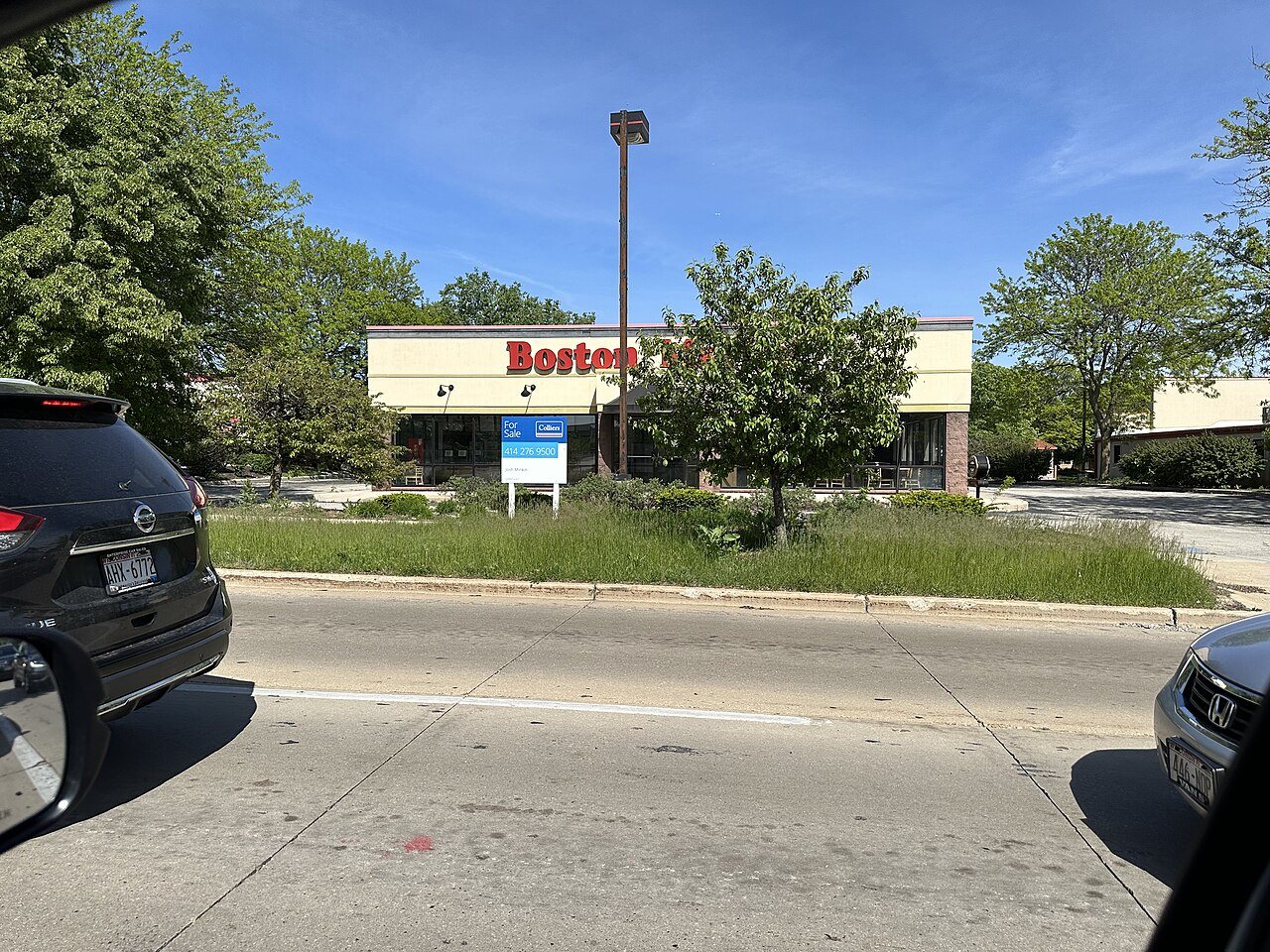
How a Newton chicken shop turned into a Wall Street story
Boston Market began in 1985 as Boston Chicken, a single storefront in Newton, Massachusetts, opened by Steven Kolow and Arthur Cores, two Northeastern University students selling rotisserie chicken at fast-food speed.
The pitch was a home-cooked dinner nobody had to cook. It worked in one neighborhood, and then it attracted investors who knew how to scale retail fast.
Those investors came out of video rental. Scott Beck and Saad Nadhir had run Blockbuster franchises before they took control of the chicken chain, and they moved its headquarters out of Massachusetts and started signing area developers across the country.
The growth was close to vertical. The Washington Post counted it in 1998: 34 stores in the Northeast in May 1992, 1,143 restaurants nationwide six years later. The name became Boston Market in 1995, once turkey, meatloaf and ham joined the chicken.
Wall Street paid up for it. The stock was priced at $20 a share in November 1993 and shot to nearly $50, and it split two-for-one in 1994. For about four years, a family dinner chain was one of the hottest equities in the country.
Why did Boston Chicken file for bankruptcy in 1998?
Because the stores were financed with debt that the parent company had issued to its own franchise developers, and the sales could not cover it.
Boston Chicken lent money to the area developers who opened its restaurants, then booked the interest on those loans. That made the parent look profitable while the restaurants underneath it did not earn enough to repay anything.
Sales flattened in 1997 and 1998 as supermarkets moved into the exact business Boston Market had invented: a hot roasted chicken and two sides, bought on the way home. The Washington Post attributed the weak results to competition from grocery chains selling ready-to-eat meals.
On October 5, 1998, the company filed for Chapter 11 and closed 178 restaurants the same day. It could not finish its restructuring before October 17, when about $283 million in debt came due.
Roughly a third of the chain was gone within days of the filing, and the rest was sold as a brand rather than rebuilt as a business.
Who owns Boston Market now?
Engage Brands, a company controlled by the real estate investor and restaurant franchisee Jay Pandya, has owned Boston Market since April 2020.
McDonald's bought the brand out of its troubles in 2000 and never made it grow, then sold it to the private equity firm Sun Capital Partners in 2007. Sun Capital held it for 13 years and sold it to Pandya's Engage Brands, when the chain still had more than 300 US restaurants.
The last two decades read like Sears: each owner smaller and further from the original operator, each one treating a familiar name as an asset rather than a kitchen.
Pandya also bought Corner Bakery, and he has filed personal bankruptcy twice. Both filings were thrown out, one because he did not produce insurance documents for properties he owned, the second because he missed court deadlines, and a judge barred him from filing again for at least six months.
Nobody at Engage Brands has announced a shutdown. The restaurants simply stopped, one address at a time, without press releases.
Rent, wages and stop-work orders: what actually closed the stores
Not consumer taste. Unpaid bills. Landlords evicted Boston Market over rent, suppliers sued over invoices, and state agencies shut restaurants over taxes and payroll.
The clearest record is in New Jersey. In August 2023 the state Department of Labor and Workforce Development issued stop-work orders at 27 Boston Market restaurants after complaints from workers, and the investigation found wages that had gone unpaid or been paid late.
The order was lifted in September 2023, after the company paid more than $630,000 in back wages to 314 workers. New Jersey Labor Commissioner Robert Asaro-Angelo put the message plainly in the department's announcement that month: "if you don't pay your workers, we will shut you down."
Colorado took a similar route. Revenue officials seized the company's headquarters in Golden and its three remaining restaurants in the state in May 2023 over unpaid sales and payroll taxes, then released them once the bill was settled.
Closures that arrive by sheriff's notice do not get a farewell sign, which is why so many Boston Market regulars found a locked door and an unchanged menu board.
Six addresses and three answered phones
In 2026 the count is small enough to verify by hand, and Restaurant Business did exactly that. The company's own website listed six restaurants: two in New Jersey and one each in Texas, Pennsylvania and New York.
The trade publication called all six. Three were open and operating, two calls went unanswered, and the sixth returned a busy signal.
That is the end of a very steep line. Boston Market went into the pandemic with just under 400 restaurants and finished 2025 with 15, according to Technomic.
Massachusetts, where the first store opened, has had no Boston Market since 2025. The chain that started in Newton has nothing left in its home state.
For comparison, Kmart is down to a handful of US stores and still maintains an accurate store locator. Boston Market's locator kept pointing customers at restaurants that had already closed.
The name itself is not dead. Boston Market frozen dinners are still stocked in American supermarkets, made under license by Bellisio Foods and run as a separate business from the restaurants. A franchised store also opened in Delhi in December 2024, and it closed after its landlord sued over unpaid rent.
The $38 million judgment nobody turned up to fight
The most detailed account of how the money moved comes from a lawsuit over the other chain Jay Pandya bought.
SSCP Restaurant Investors, which now owns Corner Bakery, took Pandya, his son Ronak, Boston Market and Pandya Restaurant Growth Brands to court in 2024. It accused them of transferring $34 million out of Corner Bakery "without justification."
The filing described "shocking, systemic breaches of fiduciary duties" and "a near complete dereliction of the finance, accounting and record-keeping functions" that a company is obliged to perform.
Boston Market and Pandya Restaurant Growth Brands never answered the complaint and were declared in default, and a federal judge awarded SSCP $38 million. Process servers could not reach Jay Pandya himself, so he was dismissed as a defendant; Ronak, who was given the title of president and chief executive of Corner Bakery in 2020, stayed in the case.
A $38 million judgment against a company with six listed restaurants is not a penalty anyone expects to collect. It is a record of what was left.
Frequently Asked Questions
Is Boston Market still open in 2026?
Barely. In 2026 Boston Market listed six restaurants on its own website, two in New Jersey and one each in Texas, Pennsylvania and New York, and Restaurant Business confirmed only three of them were open when it called. There has been no Boston Market location in Massachusetts, where the chain started in 1985, since 2025.
Who owns Boston Market now?
Boston Market has been owned since April 2020 by Engage Brands, a company controlled by Jay Pandya. McDonald's owned the chain from 2000 until 2007, when it sold to the private equity firm Sun Capital Partners, and Sun Capital sold to Engage Brands while the chain still had more than 300 US restaurants.
Why did Boston Market close so many locations?
Unpaid bills rather than empty dining rooms. Landlords evicted Boston Market restaurants over rent and states acted over taxes and payroll, including stop-work orders at 27 New Jersey locations in August 2023 that were lifted only after the company paid more than $630,000 in back wages to 314 workers. Boston Market had 1,143 restaurants in 1998 and about six listed in 2026.