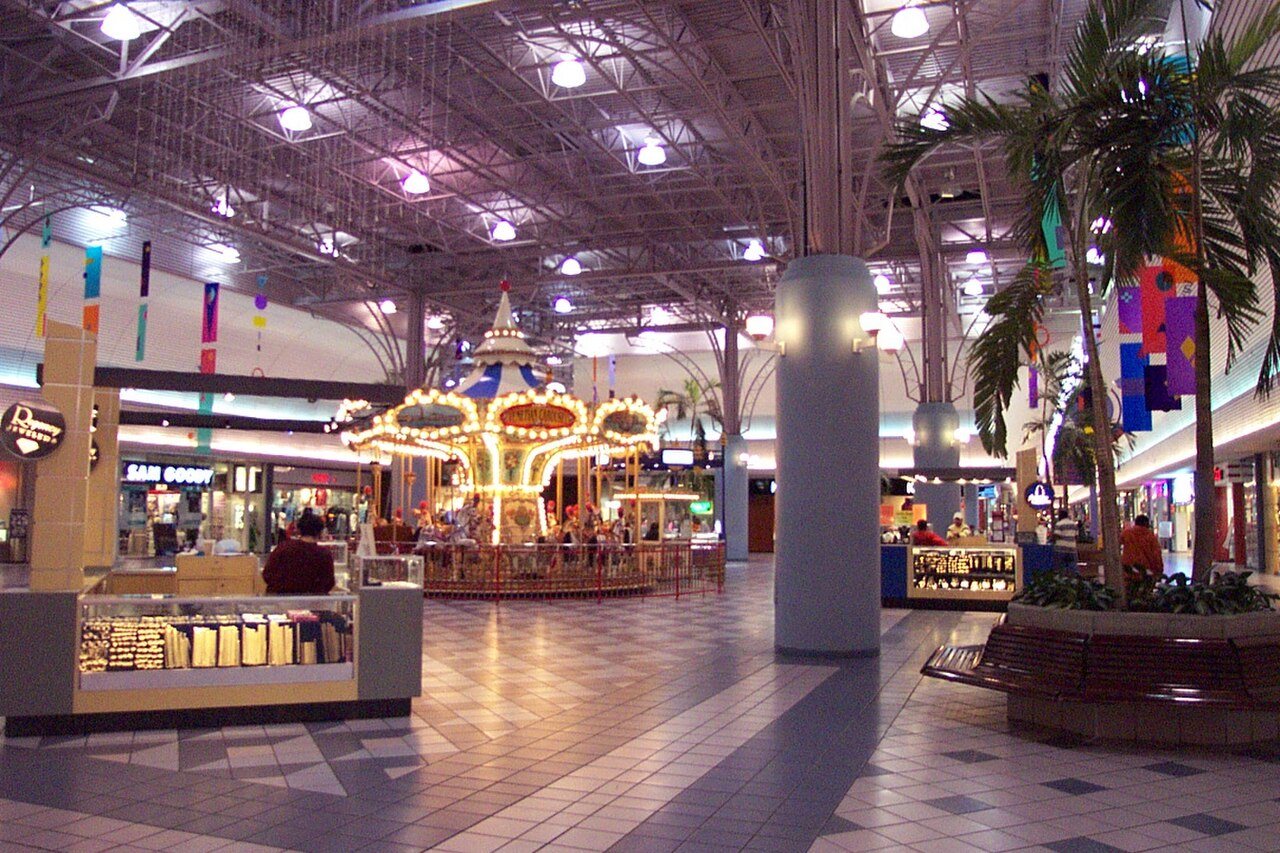
How a Manhattan record counter became a mall chain
Sam "Goody" Gutowitz opened the first store carrying his name in New York City in 1951, when the long-playing record was still a new product and most Americans bought music at a department store counter.
His method was volume and price. Goody sold records cheap, advertised hard, and treated music as an impulse purchase rather than something to save up for.
In 1978 the American Can Company bought the chain. American Can already owned Musicland, the Minneapolis company that was Goody's biggest rival, so from that point the two competitors answered to the same parent.
Musicland is what pushed the name into every mall in America. It put Sam Goody stores beside food courts, ran the Suncoast Motion Picture Company for video, and built Media Play superstores for everything at once.
By December 2000, when Best Buy made its offer, Musicland counted more than 1,300 stores drawing over 300 million customer visits a year. For a generation of American teenagers, a Sam Goody listening station was the closest thing to a streaming service.
The counterfeit tapes that put Sam Goody on trial
Long before the mall era ended, the company nearly ended itself in a federal courtroom in Brooklyn.
A sixteen-count indictment filed on February 28, 1980 charged Sam Goody, Inc., its president George Levy, and its vice president in charge of procurement, Samuel Stolon, with offenses arising from the way the company bought records and tapes.
The government's case was that in 1978 the company took delivery of more than 100,000 counterfeit eight-track and cassette tapes. The titles were the biggest sellers of the moment, including thousands of copies of the soundtracks to "Saturday Night Fever" and "Grease".
The charges grew out of an FBI undercover investigation into counterfeit product moving through legitimate retailers, an operation the bureau called Mod Sound.
A jury convicted the company and Stolon in 1981 on part of the indictment and acquitted them on the rest, and the government conceded that its evidence against Levy was insufficient. The stores stayed open, but the largest record retailer in the country had spent two years explaining in court where its inventory came from.
What Best Buy paid for Musicland, and what it lost
Best Buy announced the purchase in December 2000 and completed it at the end of January 2001. Its annual report for that year puts the price at $425.1 million in cash, including transaction costs, plus the assumption of long-term debt valued at $271.2 million.
The reasoning was distribution. Best Buy had large stores in the suburbs and nothing at all inside shopping malls, and Musicland came with more than 1,300 leases in the places where teenagers already spent their Saturdays.
Richard Schulze, Best Buy's chairman and chief executive, said in the December 2000 announcement that the deal would let the company "deliver digital entertainment technologies to consumer segments not currently served by Best Buy's store format, particularly in rural areas".
The plan was to fill Sam Goody shelves with MP3 players, cell phones and digital cameras. What arrived instead was the collapse of the compact disc, accelerated by the file-sharing era that Napster opened in 1999.
Best Buy gave up inside three years and sold the business on. The group it sold went through bankruptcy in 2006, which is where the Sam Goody name came off most mall directories.
How the 2006 bankruptcy emptied the mall directory
Musicland filed for Chapter 11 in January 2006 and announced the following month that it would close 226 Sam Goody stores and 115 Suncoast Motion Picture Company stores, and shut every Media Play location.
Trans World Entertainment, which already ran the FYE chain, bought Musicland's assets out of that bankruptcy in 2006. Between 2007 and 2008 it converted most of the surviving Sam Goody stores to FYE.
That is why the chain seemed to disappear without a farewell sale. In most malls it was not closed, it was renamed, and shoppers walked past the same shelves under a different sign.
The wider business was leaving the mall regardless. Columbia House had already lost its music club, album sales were falling every year, and the customer who used to browse for 40 minutes was downloading in four.
A handful of stores kept the old sign because nobody paid to repaint them. That accident is the only reason the name still exists at all.
Who owns Sam Goody today?
Sunrise Records and Entertainment does, through FYE. Trans World Entertainment sold the FYE chain in 2020 to Doug Putman, the Canadian retailer who also runs Sunrise Records and HMV, and the few stores still trading under older names went with it.
Sam Goody is one of those names. FYE kept a small number of locations under legacy brands, Suncoast and Sam Goody among them, instead of converting the last of them.
So the ownership answer has two steps. Nobody operates Sam Goody as a chain, and no company carries the name. The trademark and the one remaining store sit inside FYE, which sits inside Putman's group.
The count has been a single store since early 2025. Tallies through 2025 and 2026 put the United States total, and therefore the world total, at one Sam Goody, at the Rogue Valley Mall in Medford, Oregon.
Why the last store is in Medford, Oregon
By late 2024 two stores were left: one at the Ohio Valley Mall in St. Clairsville, Ohio, and one at the Rogue Valley Mall in Medford. National outlets reported in December 2024 that both were closing, and the Ohio store did close, in February 2025.
Medford refused the script. Gavin Culver, the manager of the Oregon store, denied the reports at the time. "We're going to do the last Blockbuster kind of thing because we're cool like that out here," he told Fast Company in December 2024, adding "We're not going anywhere."
The comparison is a local one. The last Blockbuster is also in Oregon, in Bend, and it has turned being the final survivor into its whole business model.
It worked. Counts through 2026 still show one Sam Goody trading, in a southern Oregon mall, selling records, movies and T-shirts to people who grew up with the sign and to teenagers who have never seen another one.
Where to find one today: there is no Sam Goody product to collect, since the company sold other people's records, so what circulates is the retail debris: yellow shopping bags, employee name badges and polo shirts, gift cards, promotional posters and standees, and the tall cardboard longboxes that CDs once shipped in. Most of it reaches buyers through Etsy's vintage Sam Goody listings, usually from former staff or from people who cleared out a store when it closed, and prices track condition and sentiment rather than scarcity, since none of it was made to be rare.
Frequently Asked Questions
Are there any Sam Goody stores left?
Yes, one. A single Sam Goody store was still trading in 2026, at the Rogue Valley Mall in Medford, Oregon, and it is the last one anywhere. The chain's other survivor, at the Ohio Valley Mall in St. Clairsville, Ohio, closed in February 2025 after a December 2024 announcement.
Who owns Sam Goody now?
Sam Goody belongs to Sunrise Records and Entertainment, the group run by Doug Putman, which bought the FYE chain from Trans World Entertainment in 2020. Trans World had acquired the Sam Goody name from Musicland's 2006 bankruptcy, and FYE still runs the last Sam Goody store as a legacy brand rather than converting it.
What happened to all the Sam Goody stores in malls?
Musicland, the owner of Sam Goody, filed for Chapter 11 bankruptcy in January 2006 and announced the following month that it would close 226 Sam Goody stores and 115 Suncoast stores. Trans World Entertainment bought what was left in 2006 and converted most of the remaining Sam Goody locations to FYE between 2007 and 2008.