Does AOL still exist in 2026?
Yes. AOL still exists, and it is not a shell or a parked domain. It runs a free webmail service, a news and lifestyle portal, and a set of paid subscription plans that real people renew every month.
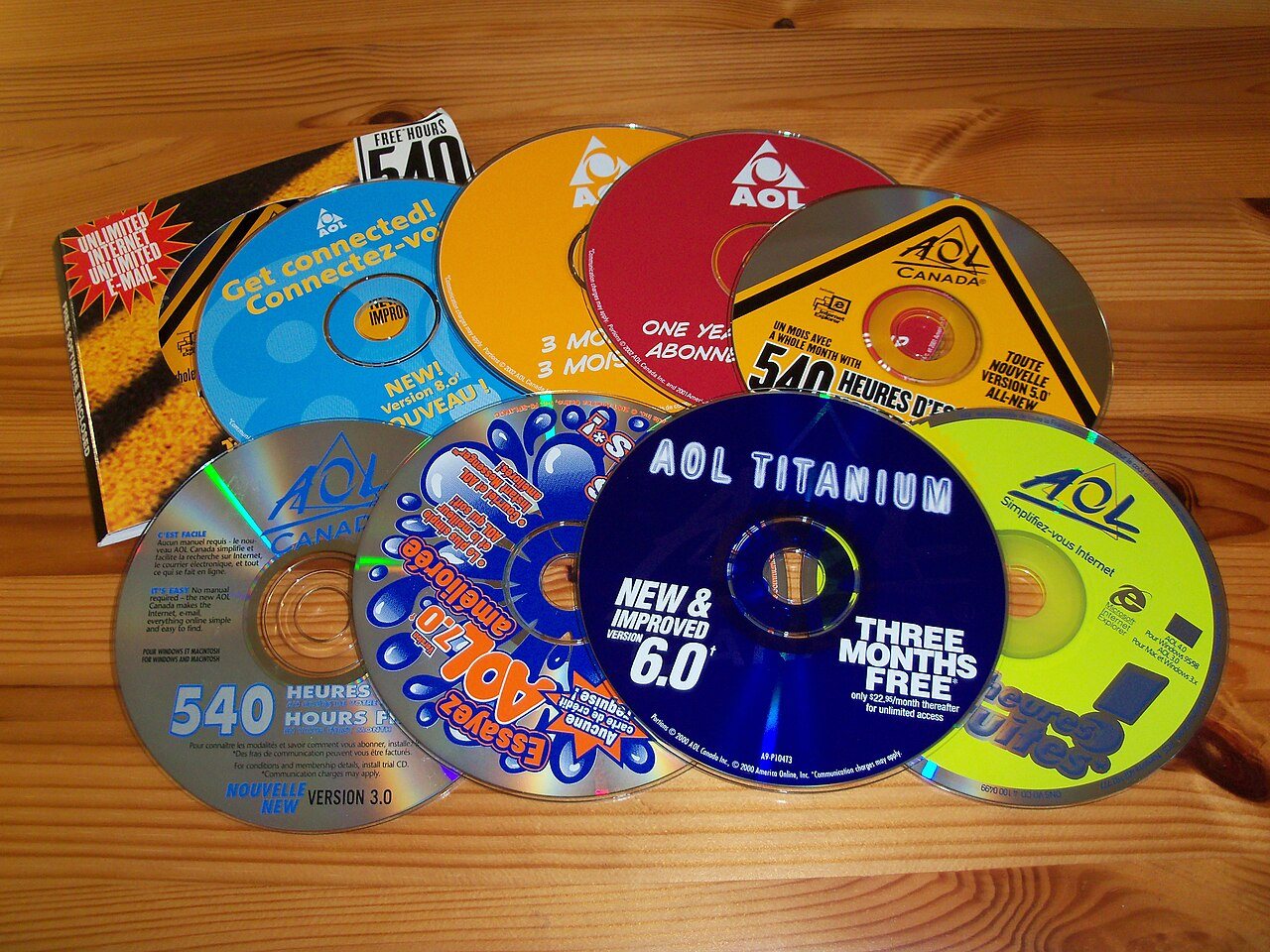
The company that once mailed America hundreds of millions of free trial discs is now a mid-size internet business with a straightforward job: keep tens of millions of email accounts working. When Bending Spoons agreed to buy AOL, chief executive Luca Ferrari put the audience at roughly 8 million daily active users and 30 million monthly active users, and described AOL as one of the ten most-used email providers in the world.
What no longer exists is the part everyone pictures. The modem handshake is gone. AOL shut off dial-up internet access on September 30, 2025. Email, the portal and the paid plans all survived that cut.
Who owns AOL now?
AOL is owned by Bending Spoons, a Milan-based software company that buys aging internet products and rebuilds them. The same firm owns Evernote, Vimeo, Meetup and WeTransfer.
The deal was announced on October 29, 2025 and reported at roughly $1.5 billion by the Wall Street Journal and Axios, with Reuters putting it closer to $1.4 billion. It closed on January 2, 2026, when Bending Spoons acquired AOL Holdco I LLC, a fact the company later confirmed in its Form F-1 registration statement filed with the U.S. Securities and Exchange Commission.
Ferrari said "Bending Spoons has never sold an acquired business" and framed the purchase as a long-term hold rather than a flip.
How AOL got passed down four times
The ownership chain is short and expensive. Verizon bought AOL in 2015 for $4.4 billion, then bought Yahoo in 2017 for $4.8 billion, then wrote down about half the combined value of both brands in 2018.
In 2021 Verizon sold the whole media group to private equity firm Apollo Global Management for $5 billion. Apollo renamed it Yahoo and kept AOL inside it. Verizon held on to a 10 percent stake.
Five years later Apollo sold AOL alone for about $1.5 billion. That is a third of what Verizon paid for AOL by itself in 2015, and a rounding error against the AOL Time Warner merger that valued the company in the hundreds of billions in 2001. Each owner bought AOL for a different reason. Verizon wanted an ad business. Apollo wanted cash flow. Bending Spoons wants a subscription base it can price and improve.
What does an AOL subscription cost in 2026?
AOL Desktop Gold, the paid browser and mail client that most subscribers actually use, is listed at $9.99 a month on AOL's own product page, with a 30-day free trial. That is the $10 a month figure people ask about.
For that price the plan includes anti-keylogging and screen-grab protection, anti-phishing tools, mail filtering that collects every attachment or image from a sender in one place, two-step verification, encryption of information stored in AOL Desktop, and live phone or chat support advertised as available 24 hours a day, seven days a week.
The wider AOL Advantage plans are harder to price from the outside. The comparison site Allconnect lists AOL Advantage at $9.99 a month, while AOL's own pages have pointed to bundles running from $11.99 to $16.99 a month, mostly built around technical support and identity theft protection from partners such as LifeLock and McAfee.
None of that includes internet access. It is a software and support subscription that happens to carry the AOL name. A subscriber in 2026 is buying antivirus-style peace of mind and a phone number to call, wrapped in an interface they have used since the Clinton administration.
That is also the reason the business is worth buying. The plans renew quietly, the customers rarely leave, and the cost of keeping the lights on is low compared with what people pay.
Why did AOL kill dial-up on September 30, 2025?
AOL announced in August 2025 that dial-up would end on September 30 of that year, along with the AOL Dialer and AOL Shield software that supported it. The company said only that it "routinely evaluates its products and services" and had decided to discontinue dial-up internet.
The demand had drained away years earlier. Verizon inherited about 2.2 million dial-up subscribers when it bought AOL in 2015. By 2021 roughly 1.5 million people still paid AOL something every month, but almost none of them were dialing in. Reporting on the shutdown cited 2023 Census Bureau data showing about 163,400 Americans relied on dial-up as their only internet connection, across every provider, not just AOL.
The product itself had stopped being competitive long before that. Reporting at the time of the shutdown pegged AOL dial-up at roughly 0.056 megabits per second, which is not enough to load a modern web page, let alone stream anything.
AOL charged $25.90 a month for dial-up in 2006, according to a CNET report from the time, which was the same price as its DSL service. If you want a sense of what those subscribers were actually getting, the math on how slow dial-up really was has not aged kindly.
Can you still get dial-up internet anywhere?
Yes, just not from AOL. NetZero still advertises dial-up, including a free tier capped at 10 hours a month and a paid accelerated plan reported at $11.95 a month. EarthLink has offered dial-up at $9.95 a month for an introductory period and $24.95 a month afterward.
So dial-up is not extinct in 2026. It is a niche product for people outside broadband coverage, sold by companies that never made it the center of their identity the way AOL did.
AOL's other 1990s assets did not all make it this far. AIM was shut down in 2017, and the AOL Time Warner content empire was broken up and sold in pieces. Email is the one thing that kept compounding, because changing an email address is genuinely annoying and most people never bother.
Frequently Asked Questions
Is AOL Mail still free?
Yes. AOL Mail remains free to use with ads in the inbox, and it does not require any paid AOL plan. The paid plans add software such as AOL Desktop Gold, security tools and live support, not access to the mailbox itself.
Can I still get AOL dial-up internet in 2026?
No. AOL ended dial-up on September 30, 2025 and retired the AOL Dialer and AOL Shield software with it. Other providers including NetZero and EarthLink still sell dial-up, so the technology exists, just not under the AOL brand.
Why do people still pay AOL every month?
Mostly for support and security rather than internet access. Roughly 1.5 million people were still paying AOL in 2021, and the plans they bought were built around technical help, identity theft protection and the AOL Desktop Gold software, which AOL lists at $9.99 a month.