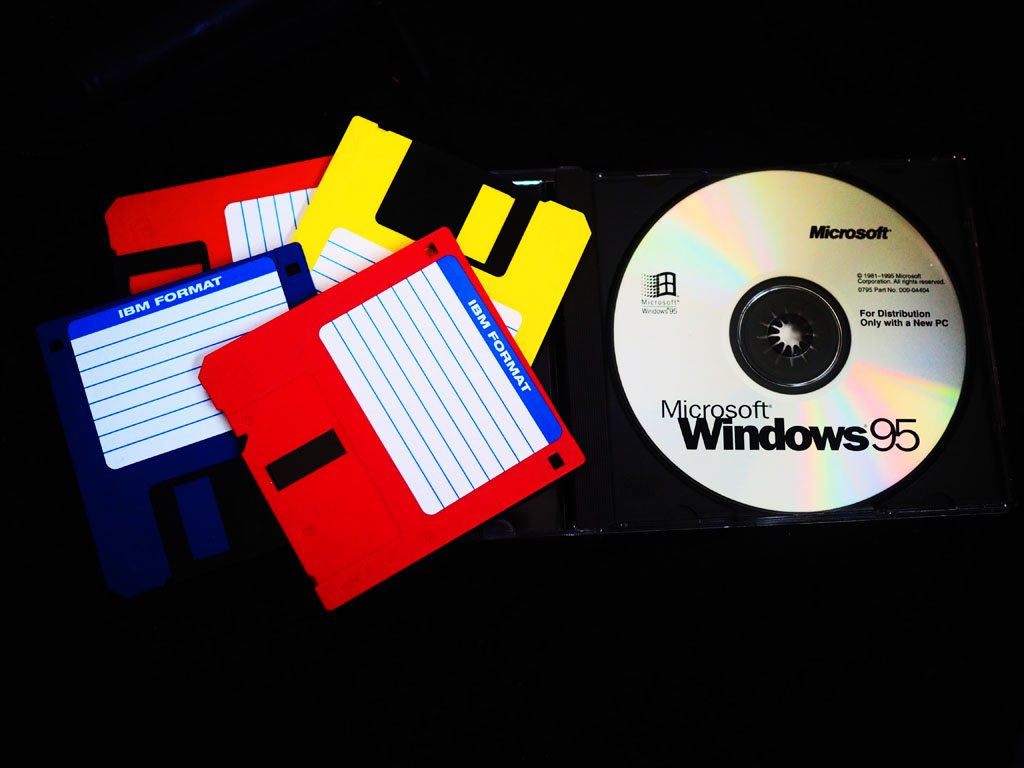
Can you still hear the Windows 95 startup sound in 2026?
Yes, and it is free. The Internet Archive hosts the original Windows 95 system sounds as downloadable files, released under a CC0 public domain dedication, with the startup chime available as WAV, FLAC or MP3. A second Archive item offers a cleaned-up stereo transfer of the same recording.
What you cannot do is get it from Microsoft. The company replaced Brian Eno's piece with a new startup sound in Windows 98 and has never shipped it again in a consumer release of Windows.
The file to look for is named The Microsoft Sound.wav. On a 1995 machine it lived alongside Chimes, Chord, Ding and Tada, and it only played at all if the PC had a sound card installed. Plenty of office PCs in 1995 did not, which is why some people who used Windows 95 every day have no memory of the sound whatsoever.
Who wrote the Windows 95 startup sound?
Brian Eno, the English producer and ambient composer behind "Ambient 1: Music for Airports" and records by U2 and David Bowie. Microsoft designers approached him in 1994, and the piece first appeared in a Windows build in May 1995, three months before Windows 95 went on sale at midnight on August 24.
Eno described the commission to San Francisco Chronicle critic Joel Selvin in a June 1996 interview. The brief, he said, came from an agency and asked for "a piece of music that is inspiring, universal, blah-blah, da-da-da, optimistic, futuristic, sentimental, emotional," a whole list of adjectives, "and then at the bottom it said, and it must be three and a quarter seconds long."
He took it because he was stuck. "The idea came up at the time when I was completely bereft of ideas," he told Selvin. "I really appreciated someone coming along and saying, Here's a specific problem, solve it."
Microsoft's own proposal, quoted in the Library of Congress essay on the recording, asked for something that would "capture the spirit of innovation, feel contemporary, and convey a more approachable, human side of the brand."
Eighty-four versions, written on a Macintosh
Eighty-four is the number Eno gave Selvin in 1996. The Library of Congress essay by Eno biographer David Sheppard puts it at more than 80.
The scale of the job is the part he kept talking about afterward. "It's like making a tiny little jewel," he said. "I got completely into this world of tiny, tiny little pieces of music. I was so sensitive to microseconds at the end of this that it really broke a logjam in my own work." When he went back to normal work, "pieces that were like three minutes long, it seemed like oceans of time." His own 1985 album "Thursday Afternoon" is a single unbroken piece lasting an hour.
He also did not own a PC. Asked by BBC Radio 4 in 2009 whether he had composed the Windows music on a Windows machine, Eno said he wrote it on a Mac, adding, "I've never used a PC in my life; I don't like them."
Why the brief said 3.25 seconds and the file runs six
The version Microsoft shipped is roughly twice the length it asked for. Download The Microsoft Sound.wav from the Internet Archive and it clocks in at about 6.1 seconds. Wikipedia describes it as a six-second start-up sound, and the German archive winhistory.de lists the Windows 95 chime at about 6 seconds against 7 for Windows 98 and 4 for Windows XP.
The Library of Congress addressed the gap directly when it took the recording in. The finished clip was twice as long as Microsoft's engineers had asked for, and the company used it anyway because it conveyed the sense of welcome and progress they wanted for the launch.
So 3.25 seconds is the brief, not the artifact. The piece Sheppard describes as the chosen one, "all 3.25 seconds of it," is a bell-like attack followed by a decaying electric-piano figure over a synth pad. What plays when the machine boots is that idea with room to breathe.
One footnote on the famous number. Microsoft's own developer blog, most reprints and the Library of Congress essay all quote the brief as three and a quarter seconds. An archived transcript of the 1996 Chronicle interview reads "three-and-a-half seconds." The 3.25-second figure is the one Microsoft and the Library use.
Why later versions of Windows dropped the startup sound
Windows 98 replaced Eno's piece with a seven-second crescendo by Microsoft sound engineer Ken Kato. Windows XP got a shorter one. For Windows Vista, Microsoft flew in King Crimson guitarist Robert Fripp, and its Channel 9 developer channel published behind-the-scenes footage of the session in January 2006. That Vista sound carried into Windows 7. The same era gave Windows the Bliss wallpaper and a house style that treated boot-up as an event.
Then it stopped. Jensen Harris, the lead user-interface designer on Windows 8, killed the startup sound partway through development. He told the podcast Twenty Thousand Hertz that opening a laptop with a sleeping baby on his arm and having the machine announce itself convinced him that a device used in bedrooms and libraries should not make noise by default. Dropping it also saved boot time and memory, which mattered as Microsoft pushed Windows onto smaller devices.
The sound file stayed in Windows 8, buried and renamed Windows Logon, and stayed off by default through Windows 8.1 and Windows 10.
Windows 11 brought it back in 2021, on by default, playing when the PC reaches the lock screen. Accessibility drove the reversal, because blind and low-vision users needed an audible signal that the machine had finished booting. The new chime is called Petals, designed by Phi Bui, and Microsoft has described it as a small idea blooming into something greater.
What happened to the Microsoft Sound in 2025
On April 9, 2025, the Library of Congress named the Windows start-up chime to the National Recording Registry, in a class of 25 recordings that also included the original Broadway cast album of "Hamilton," Amy Winehouse's "Back to Black" and the Minecraft soundtrack. The entry is filed as "Windows Start-Up Chime, Brian Eno (1995)," with an essay by David Sheppard, who published the Eno biography "On Some Faraway Beach" in 2008.
The Library's stated reason had less to do with the music than with the machine. Windows 95 moved more of the computer's operation under a graphical interface and made a home PC usable by people who were not specialists, and the chime is the sound that announced it.
Six weeks later the fee became public. In May 2025 Eno published an open letter criticizing Microsoft's supply of cloud and AI services to Israel's Ministry of Defense and said he would give his original $35,000 composition fee to Palestinian aid. His work for the company in the early 1990s, he wrote, "represented a gateway to a promising technological future."
Sheppard's essay ends on a flat note for anyone hoping for a sequel: those waiting for a new Brian Eno computer startup sound are probably in for an infinite wait.
Frequently Asked Questions
Was the Windows 95 startup sound really 3.25 seconds long?
The brief was. The shipped file was not. Microsoft's agency asked for three and a quarter seconds, and Eno delivered pieces to that spec, but the version that ended up on the Windows 95 disc runs about six seconds. The Library of Congress noted that the final clip was twice as long as the engineers requested.
How much was Brian Eno paid for the Windows 95 sound?
$35,000. Eno confirmed the figure himself in May 2025, when he announced he was donating that fee to Palestinian aid as part of an open letter criticizing Microsoft's contracts with Israel's Ministry of Defense.
Does Windows 11 still have a startup sound?
Yes. Windows 11 restored the startup sound in 2021 and turns it on by default. It is a new composition called Petals by Phi Bui, not Eno's, and you can switch it off in the Sounds control panel by clearing the "Play Windows Startup sound" checkbox.