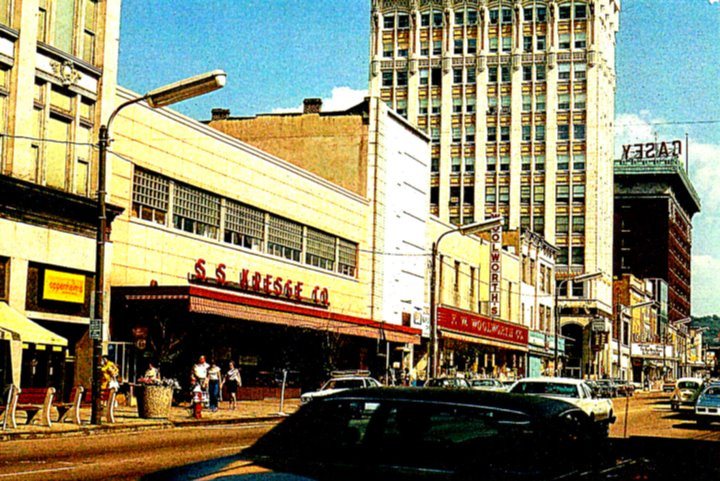
Why the five-and-dime ran out of customers
Frank Winfield Woolworth opened his first lasting store in Lancaster, Pennsylvania, in 1879, selling nothing above ten cents and putting the goods out where shoppers could handle them before paying. That model carried the company for 117 years.
It did not survive the move of American retail out of downtown. By the middle of the 1990s the variety store side of Woolworth Corporation was shrinking fast, and the count of general merchandise stores in the United States fell from 1,465 to 400 in five years, as The Washington Post reported in July 1997.
The financial picture was worse than the store count suggested. In the quarter that ended April 26, 1997, the F. W. Woolworth division lost $24 million on $224 million of sales, according to the company's own filing with the Securities and Exchange Commission. A division losing that much on that little revenue has no route back.
Woolworth was not alone in the squeeze. Kmart and Sears spent the same decade learning that a store built for 1965 shoppers does not hold 1995 ones.
What Roger Farah announced on July 17, 1997
On July 17, 1997, Woolworth Corporation told the Securities and Exchange Commission that it was leaving the domestic general merchandise business. All 400 remaining F. W. Woolworth stores in the United States would be closed, sold or converted to something else.
Roger N. Farah, then chairman and chief executive, put it plainly in the filing: "We made the very difficult decision to close our domestic F.W. Woolworth general merchandise operations to help assure the continuing profitable growth of the Woolworth Corporation." The same filing said the business had kept losing money and could not be returned to profitability.
About 100 of the better locations were converted to Foot Locker, to a larger Champs Sports format, or to other specialty stores. The rest were closed or sold, along with the distribution center in Denver, Pennsylvania, that had supplied them.
The Washington Post counted 9,200 employees losing their jobs, 3,600 of them full time and 5,600 part time. The closings ran through the second half of 1997, ending a chain that had been open since the presidency of Rutherford B. Hayes.
How a shoe chain ended up owning the company name
Shutting the five-and-dimes left Woolworth Corporation as a holding company for specialty chains, and the healthiest of them sold sneakers. In 1998 the company renamed itself Venator Group, a deliberately blank label for a business that no longer knew what it was.
The blankness did not last. Venator kept selling the non-athletic pieces, and by 2001 there was nothing left to be vague about. On November 1, 2001, Venator Group announced that it would begin doing business as Foot Locker, Inc. the following day.
The company's own announcement said the divestitures had allowed it to be "totally focused in the athletic retail segment." At that point it ran roughly 3,600 athletic stores in 14 countries across North America, Europe and Australia, under the Foot Locker, Lady Foot Locker, Kids Foot Locker and Champs Sports banners.
So the question of whether Woolworth went out of business turns on a corporate technicality. The stores died. The legal entity, share register and all, changed its name twice and kept trading.
Who owns the company now that Foot Locker has a parent
The business that used to be Woolworth is not independent any more either. Dick's Sporting Goods completed its purchase of Foot Locker, Inc. on September 8, 2025, in a deal valued at about $2.4 billion, which makes Dick's the corporate descendant of a five-and-dime chain founded in 1879.
The store count is still moving. Dick's reported 2,478 stores in the Foot Locker business as of August 1, 2026, covering the Foot Locker, Kids Foot Locker, Champs Sports and WSS banners, after closing dozens of locations it judged unproductive.
There is no Woolworth store anywhere in the United States, and there has not been one since 1997. The trademark did not disappear with the shelves: Foot Locker, Inc., now owned by Dick's, is the direct successor to the F. W. Woolworth Company and holds the American rights to the name.
That is the pattern that also swallowed RadioShack. The signs come down, the trademark keeps changing hands, and the name outlives the business it described.
Why Europe has about 1,000 Woolworth stores in 2026
American searches for Woolworth keep colliding with a chain that is very much alive. Woolworth Deutschland is a separate German company, and it has been opening stores at speed while the American original is a footnote.
In March 2026 it opened its one thousandth store in Europe, at the Kronenberg Center in Essen. Roman Heini, who runs the business, said in a statement that "The 1000th store is an important step for us and confirms the viability of our business model."
The chain runs around 850 stores in Germany and also trades in Austria, Poland, the Czech Republic and Slovakia, selling cheap household goods, clothing and stationery at fixed low prices. Management has talked publicly about reaching 5,000 European locations in the long run.
The link back to Frank Winfield Woolworth is historical rather than corporate. The German business began as a prewar subsidiary of the American company and has been separately owned for decades, so buying a mug in a German Woolworth sends nothing to Dick's Sporting Goods.
The lunch counter that outlived the chain
One Woolworth interior still draws visitors every week. On February 1, 1960, four Black students from North Carolina Agricultural and Technical State University sat down at the whites-only lunch counter of the Woolworth store in Greensboro, North Carolina, and stayed in their seats after service was refused.
The sit-in spread across the South within weeks and became one of the defining actions of the civil rights movement. The Greensboro building is now the International Civil Rights Center and Museum, which is why that address is the one Woolworth site most Americans can still name.
Where to find one today: the chain left behind a great deal of small, cheap, well-made stuff. Lunch counter china, store signs, paper bags, employee badges and Christmas ornaments all circulate among collectors, and a search for five-and-dime memorabilia on Etsy is the practical way to browse them. Condition and whether a piece actually carries the store logo drive the asking price more than age does, so compare several listings before buying.
Frequently Asked Questions
Did Woolworth become Foot Locker?
Yes. The F. W. Woolworth Company, trading as Woolworth Corporation, renamed itself Venator Group in 1998 after closing its American five-and-dime stores, then began doing business as Foot Locker, Inc. on November 2, 2001. It is the same legal entity under a new name, not a buyer of the old one.
When did Woolworth close its stores in the United States?
Woolworth Corporation announced on July 17, 1997 that it was shutting the 400 F. W. Woolworth variety stores still trading in the United States. About 100 were converted to Foot Locker and other specialty formats and the rest were closed or sold, which ended the American five-and-dime chain after 117 years.
Who owns the Woolworth name today?
In the United States the Woolworth trademark belongs to Foot Locker, Inc., the renamed Woolworth Corporation, which Dick's Sporting Goods acquired in a deal completed on September 8, 2025. In Europe the Woolworth name is run by a separate German company, Woolworth Deutschland, which opened its one thousandth store in March 2026.