How a shareware download became the button everyone clicked
In 1991 a zip file was not a convenience. It was the only way to fit a program onto one of the floppy disks everybody carried, or to send it down a phone line without tying it up all afternoon.
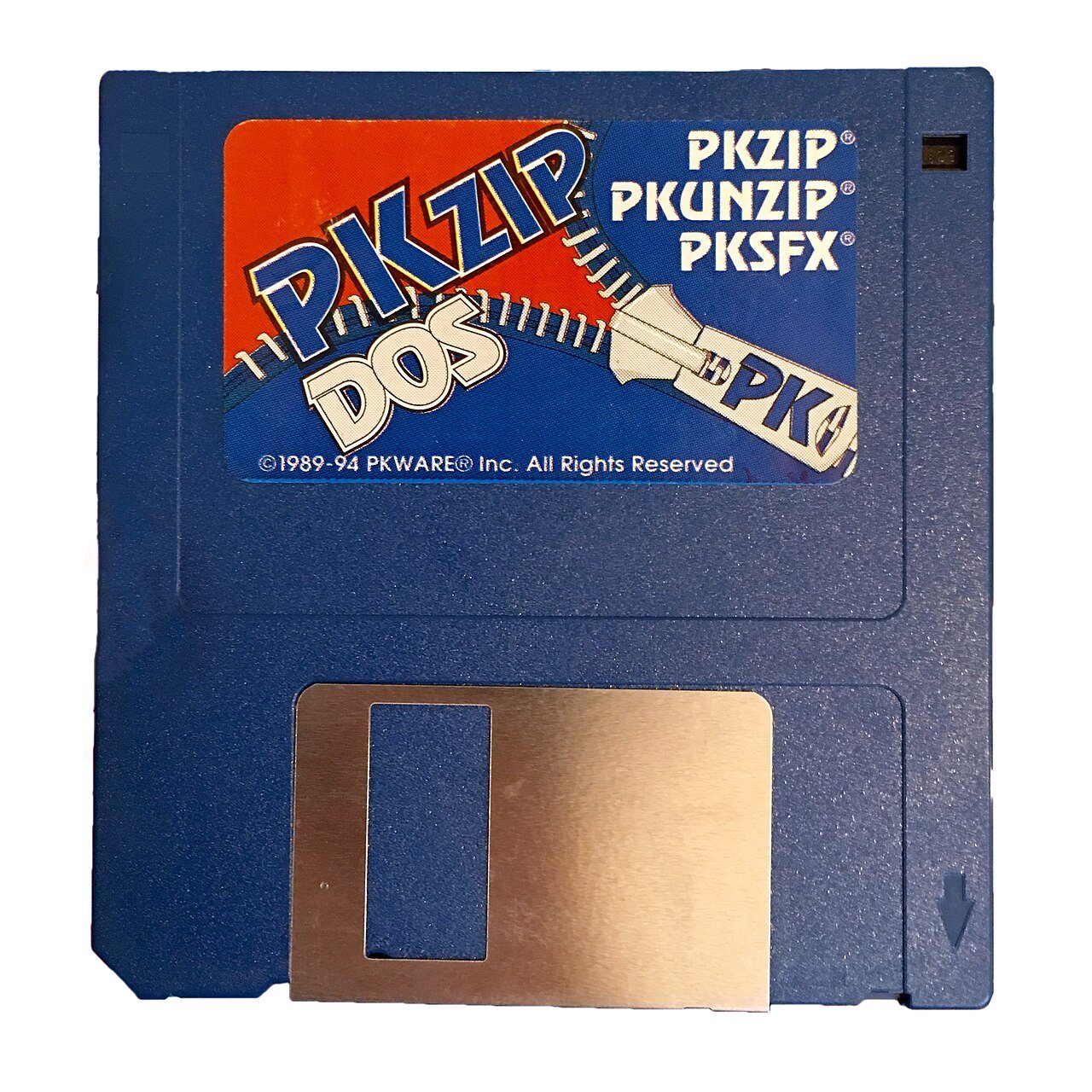
The tool that made those archives, PKZIP, ran at a DOS command prompt. Nico Mak, then working at Mansfield Software Group, wrote a graphical front end for it. He had already shipped PMZIP for OS/2 in January 1991, and WinZip 1.0 followed for Windows in April 1991, published under the name Nico Mak Computing.
What it did was small and enormous at the same time. It put the contents of a zip file into a window, so unpacking a download became a double click instead of a typed command with switches.
It was shareware with teeth. The help file gave users 21 days, then asked for $29, and the payment instructions read exactly like 1991: “Payments must be in US dollars drawn on a US bank,” mailed to a post office box in Bristol, Connecticut.
The same file warned that running WinZip past the trial was “in violation of federal copyright laws.” The program kept working anyway, showing a reminder screen instead of a lock, and that reminder screen is the part most people still remember.
Is WinZip still sold in 2026, and who sells it?
Yes. WinZip is a shipping commercial product in 2026, sold by Corel Corporation, the company that bought it in 2006 and has kept it in the catalog ever since.
Corel's own standing changed this year. On May 5, 2026 Corel relaunched as an independent company backed by Vector Capital, after Vector acquired the group's creativity and productivity brands, WinZip among them, and left the Parallels business behind.
Three editions are on sale. Third-party pricing listings in 2026 put WinZip Standard at roughly $35 a year, Pro at roughly $55 a year and the Ultimate bundle near $90 a year, with a free trial still attached to the download. Promotions move those figures, so treat them as a band rather than a sticker price.
Put the two eras side by side and the arithmetic is blunt. In 1991, $29 bought WinZip outright and forever. In 2026 the cheapest edition asks more than that every twelve months, which is the same pattern that shows up across what 90s software and hardware cost once subscriptions arrived.
Perpetual licenses have not vanished. WinZip 29, the current release, is still listed by business software resellers as a one-time purchase, so the annual plan is not the only door.
Who bought WinZip, and in what order
The ownership chain is shorter than the product's age suggests. Nico Mak Computing became WinZip Computing, and on January 18, 2005 the private equity firm Vector Capital bought the business, a date Corel's later filings use as the start of WinZip's numbers in its accounts.
Sixteen months after that, the program changed hands again. Corel “acquired all of the outstanding securities of WinZip, a provider of compression utility software, from Vector Capital” on May 2, 2006, according to its quarterly report filed with the Securities and Exchange Commission.
Corel paid in paper rather than cash: 4,322,587 common shares, plus repayment of all of WinZip's outstanding debt. Vector Capital already controlled Corel at the time, so the filing treats the deal as a related-party transaction and reports WinZip's results from January 2005 onward.
Corel later spent a long stretch under KKR ownership and briefly traded under the name Alludo before going back to the Corel name. Then, in May 2026, WinZip ended up where it had been in 2005, inside a Vector Capital company, 21 years after Vector first bought it.
What the nag screen was actually worth
Enough to matter to a public company. Corel's filings show WinZip contributing about $19.4 million to productivity revenue in fiscal 2005, its first year inside the group.
The year after, Corel leaned on it. The company's first-quarter report credits a $5.3 million increase in WinZip revenue to “more aggressive marketing, a new version release, the implementation of a maintenance offering.”
That is the odd economics of era utilities. A program that most people ran unregistered still earned tens of millions a year, because a minority registered, corporate buyers bought licenses in volume, and the reminder screen kept asking.
Eudora funded itself on the same bargain: free to use, paid to be left alone. The difference is that WinZip solved a problem every single Windows user hit, and solved it on day one of owning a modem.
Why pay for zip when Windows does it free?
Because for most of WinZip's life, Windows did not. Microsoft shipped zip handling in Explorer from the late 1990s, first as a Plus! add-on and then as the Compressed Folders feature built into later releases, and it was deliberately basic: open a zip, drag files out, no encryption worth the name, no other formats.
That gap is where WinZip lived for two decades. If a download arrived as a RAR or a 7z file, Windows had nothing to say about it, and a free utility or a paid one had to fill in.
Windows 11 closed most of the gap. File Explorer now extracts RAR, 7z, gz and tar archives without help, using the open source libarchive project, which removed the single most common reason a normal person installed a compression tool.
The free competition got better too. 7-Zip, open source and genuinely free, compresses harder than zip, reads almost everything, and asks for nothing, which is why it sits on so many machines where WinZip used to.
What WinZip sells in 2026 is the rest of the package: AES encryption, large archive splitting, cloud and backup tools, PDF handling in the Pro tier, and an interface built for people who manage files all day rather than once a month.
Should anyone still pay for WinZip?
For opening a download, no. Windows 11 and 7-Zip cover that completely, for nothing, and have for years.
The honest case for paying is narrow and real. It is a workplace that needs encrypted archives with an audit trail, a volume license and a support contact, or a long-time user whose muscle memory is worth more than $35 a year.
Everyone else is paying for a habit formed in 1995. That is not nothing, which is roughly how WinZip survived 35 years and four owners while the thing it did became a right-click menu item.
Frequently Asked Questions
Is WinZip still a thing in 2026?
Yes. WinZip is still sold and updated in 2026 by Corel Corporation, 35 years after Nico Mak Computing released WinZip 1.0 for Windows in April 1991. It is no longer necessary for basic unzipping, because Windows 11 extracts zip, RAR and 7z archives on its own, but the paid product still ships in Standard, Pro and Ultimate editions.
How much does WinZip cost in 2026?
Third-party pricing listings in 2026 put WinZip Standard at about $35 a year, WinZip Pro at about $55 a year and the Ultimate bundle near $90 a year, with promotions moving the numbers. For comparison, WinZip cost a one-time $29 shareware registration fee when Nico Mak Computing shipped it in 1991, after a 21-day trial.
Who owns WinZip now?
WinZip is owned by Corel Corporation, which bought it from Vector Capital on May 2, 2006 for 4,322,587 shares plus repayment of WinZip's debt. Corel relaunched as an independent company backed by Vector Capital on May 5, 2026, which put WinZip back inside a Vector Capital business 21 years after Vector first acquired it in 2005.