What Happened to NCSA Mosaic, the Browser That Built the World Wide Web

In January 1993, a 22-year-old computer science student at the University of Illinois at Urbana-Champaign was earning $6.85 an hour writing code in a beige basement office. Six months later, the software he and a colleague had built would be the most-downloaded program on the early internet. Three years later, it would be at the center of the largest IPO Wall Street had ever seen for a company with no profits. And by the year 2000, almost nobody was using it anymore.

The software was called Mosaic, and the student was Marc Andreessen. The story of NCSA Mosaic is the story of how a research project at a public university became, briefly, the center of gravity for the entire internet. It is also the story of how that center moved fast, fragmented faster, and ended up reshaping the next thirty years of how humans interact with information.

Most people remember the browser wars of the late 1990s. Far fewer remember the browser before the war started. Mosaic was that browser. It is the missing chapter in the standard internet history.

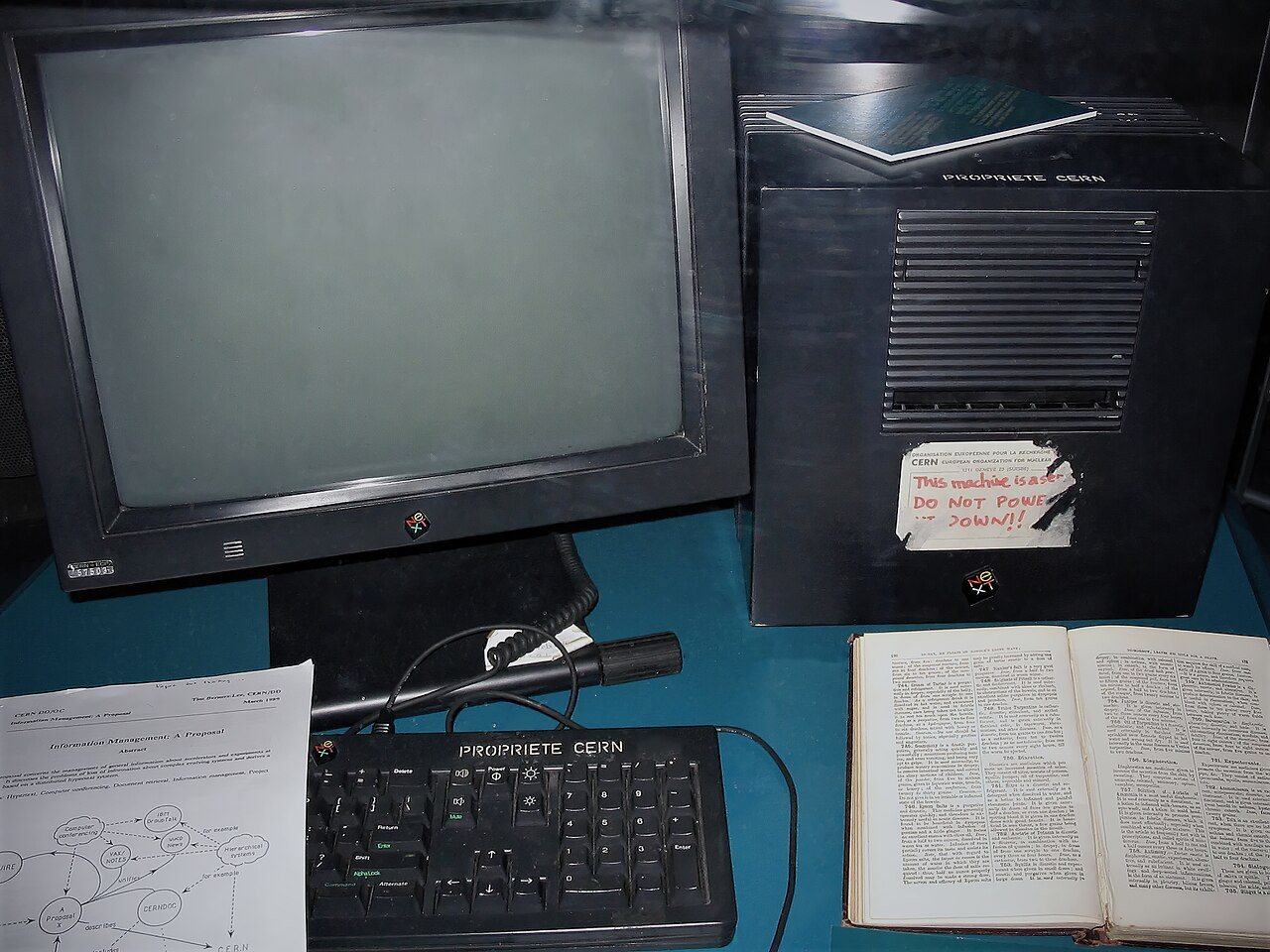
The NeXT computer Tim Berners-Lee used as the first web server at CERN, with a handwritten label that reads 'This machine is a server. Do not power down.'
Tim Berners-Lee's NeXT workstation at CERN, the first web server on the World Wide Web. By late 1990 it was running the first browser too. Mosaic, released in early 1993, was the software that finally made the system Berners-Lee invented feel mainstream.

The World Before Mosaic

To understand what Mosaic actually did, you have to understand how strange the internet was before it. By 1992, the internet was about a decade old as a public network. There was email. There were Usenet newsgroups, which were essentially threaded message boards. There was FTP for moving files around, Gopher for navigating menus of documents, and a handful of niche protocols nobody outside academia had ever touched.

Tim Berners-Lee, working at the European particle physics lab CERN, had proposed a system he called the World Wide Web in 1989. By late 1990, he had built the first server and the first browser. The browser was named WorldWideWeb, ran only on his NeXT workstation, and was essentially text-only. By 1992, his system had grown into a small constellation of academic servers and a handful of browsers built by other researchers, most notably one called ViolaWWW. None of them had reached anything like a popular audience.

The web in 1992 was a graduate-student tool. It was useful for sharing physics papers and lab documentation. It was not useful for almost anyone else. And the reason was not just that it was unfamiliar. It was that the available browsers were either text-only or so primitive in their visual design that they did nothing to suggest the web could be a medium for normal humans.

Inside NCSA: The Government-Funded Sandbox

The National Center for Supercomputing Applications was founded at the University of Illinois at Urbana-Champaign in 1986, funded primarily by the National Science Foundation. The mission was straightforward: make supercomputers useful. NSF had decided to fund several supercomputing centers around the country, and one of them needed to figure out how to put a friendly interface on these enormous, expensive machines so that researchers in other fields could actually use them.

That mandate, "build interfaces that make hard things accessible," is what made NCSA the right place for Mosaic. The center had a culture of building software that real people could use. It had access to high-end Unix workstations. It had a steady stream of undergraduate and graduate computer science students looking for something interesting to work on. And in 1992, two of those students, Marc Andreessen and Eric Bina, started building a graphical browser for the World Wide Web.

Andreessen was the project lead and the user-facing voice. Bina was the systems engineer who actually figured out how to make the rendering work. They started on the X Window System, which was the standard graphical environment on Unix workstations of the era. They called the early version xmosaic. Bina did most of the heavy lifting on the parsing engine and the rendering pipeline. Andreessen drove the user interface design and, crucially, the public communication. He was the one who would post on mailing lists, respond to user feedback, and push for features.

Andreessen, at the time, was a junior earning $6.85 an hour as an NCSA programmer. He spent more time at the lab than in class. The work fit a pattern that would later become familiar in tech: a young, talented programmer who barely sleeps, working on something his bosses do not fully understand, building infrastructure that will eventually outpace the institution that paid for it.

January 1993: The Release

Mosaic version 0.5 was released for the X Window System on January 23, 1993. It was free. It was downloadable from NCSA's anonymous FTP server. And it was good enough that it started spreading immediately.

The first month, NCSA recorded around 5,000 downloads. By March, that number was higher. By April, when version 1.0 was released, the team had ports underway for Mac and Windows. By the end of 1993, ports for both platforms had shipped, which was the part that really mattered. The Unix workstation market was small. The Mac and Windows market was enormous. Once Mosaic existed on the operating systems regular people actually used, the web stopped being a tool for graduate students and started becoming something else.

Mosaic 1.0 was free, easy to install, and did something none of its predecessors had done: it made the web feel like a place. The graphics were small. The layouts were primitive. But you could click a link and arrive somewhere new, and that was new.

What Mosaic did differently was a combination of small decisions that, taken together, mattered enormously. The interface was point-and-click in a way that earlier browsers were not. The "back" button was prominent and reliable. URLs were visible in an address bar at the top of the window. Bookmarks were a first-class feature. There was a forms interface that worked well enough to support the first interactive web pages. And there was the IMG tag.

The IMG Tag: A Decision That Reshaped the Web

On February 25, 1993, Marc Andreessen sent a message to the WWW-Talk mailing list announcing a new HTML element he and Bina had been working on. The element was called IMG, and it allowed Mosaic to display images inline with text on a web page. Earlier browsers had handled images by opening them in a separate viewer window. Mosaic showed them right where they belonged, embedded inside the document.

Tim Berners-Lee was, by all accounts, hesitant about the proposal. He preferred a more general approach using extensions of existing tags rather than a new element. He told Andreessen, in effect, that he did not want to add new HTML tags until the specification had gone through a more formal review process. Andreessen's reply was not really a reply. By the time he had emailed the mailing list, Bina had already implemented IMG. The release shipped with it. The genie was out of the bottle.

This is one of the most consequential design decisions in the history of the web. IMG turned web pages from documents into visual media. It made the web something a graphic designer could care about. It made personal home pages possible, because people wanted to share photos. It made news sites work, because layouts needed images. It made advertising work, because banner ads needed images. The entire visual language of the modern internet, from product photography to memes to TikTok thumbnails, traces back to a 22-year-old student deciding that Tim Berners-Lee's caution was not going to slow him down.

Andreessen has been criticized for the unilateral move. Berners-Lee was right that more careful design would have produced cleaner standards. But the alternative was waiting, and waiting was the one thing nobody on the web in 1993 could afford to do. The next year saw an explosion of websites that would have been impossible without inline images. Mosaic shipped. The web grew. The standards process caught up later, when IMG was incorporated into HTML 2.0 in 1995.

The Numbers: From Thousands to Millions

By the end of 1993, downloads of Mosaic from NCSA's servers had passed one million. By mid-1994, they had passed several million. The web itself had grown from a few hundred servers in early 1993 to tens of thousands by the end of 1994. Mosaic was responsible for almost all of the growth in non-academic web traffic during that period. Other browsers existed, but Mosaic was, by a wide margin, the one most people used.

This made NCSA, briefly, the most important software shop in the consumer internet. It also made NCSA's position increasingly awkward. The center was a research institution. It was funded by NSF. It was not built to support millions of users running its software on Mac and Windows machines around the world. The team behind Mosaic, originally a few students and staff engineers, was overwhelmed. They needed support, documentation, bug fixes, marketing. The university's bureaucracy was not designed to provide any of that.

The other thing happening in parallel was that NCSA was claiming credit for Mosaic in ways the team itself found alienating. Press releases featured center directors rather than the engineers who had built the software. Marketing materials emphasized the institution. Andreessen, in particular, felt sidelined. By late 1993, he had graduated and moved to Silicon Valley, looking for what to do next. He did not have to look long.

Jim Clark and the Birth of Netscape

Jim Clark was, at the time, the founder of Silicon Graphics, a workstation company that had peaked and was looking for new opportunities. He had heard about Mosaic. In late 1993 and early 1994, he started reaching out to people in the Mosaic community. He met Andreessen in February 1994 at a coffee shop in Palo Alto. The meeting ran long. Within weeks, they had agreed to start a company.

The company was incorporated on April 4, 1994, originally under the name Mosaic Communications Corporation. Clark put up $4 million of his own money. Kleiner Perkins joined as a venture investor. The plan was straightforward: build a better Mosaic, sell it to companies that needed to put themselves on the web, and capture the wave that was already building.

The University of Illinois objected to the name. Mosaic was their trademark. After several months of negotiation, Mosaic Communications Corporation became Netscape Communications Corporation on November 14, 1994. The product, originally called Mosaic Netscape, became Netscape Navigator. The first public version, Mosaic Netscape 0.9, was released on October 13, 1994.

It was, to put it mildly, a hit. Within four months of release, Netscape Navigator had captured roughly three quarters of the browser market. The original Mosaic team, plus several engineers Clark had hired from elsewhere, was building features at a pace NCSA could not match. Netscape Navigator added cookies, Java support, JavaScript, frames, plugins, and a user interface that felt years ahead of anything else. By 1995, Mosaic was the project that started the browser. Netscape was the browser that everyone actually used.

The Spyglass Deal: How Mosaic Became Internet Explorer

Here is where the story gets interesting from a business perspective. NCSA, recognizing that it could not commercialize Mosaic itself, licensed the technology and trademarks to a small company called Spyglass, Inc. in 1994. Spyglass was supposed to be the official commercial path for Mosaic. They built their own browser, sometimes called Spyglass Mosaic, that they marketed to enterprise customers. It was, by most accounts, fine. Not as good as Netscape, but solid.

In January 1995, Microsoft licensed Spyglass Mosaic. The deal, on paper, was structured as a $2 million upfront payment plus a per-copy royalty on every copy of the browser Microsoft sold. The browser became Internet Explorer 1.0, released in August 1995 as part of the Microsoft Plus! pack for Windows 95.

The catch was that Microsoft never sold Internet Explorer. They bundled it with Windows. Free. Every copy of Windows came with a copy of Internet Explorer at no additional charge. Microsoft argued that since they were not technically selling the browser, the per-copy royalty did not apply, and they only owed Spyglass the minimum quarterly fee.

Spyglass, watching their licensing revenue evaporate as Microsoft used Mosaic-derived code to compete with the very browsers their customers were buying, threatened a contractual audit in late 1996. On January 22, 1997, Microsoft settled with Spyglass for $8 million. Spyglass got a check. Microsoft got the browser. The original code, ultimately derived from work Andreessen and Bina had done at NCSA on a $6.85-an-hour student wage, became the foundation of the browser that would dominate the consumer internet for the next decade.

Look, the lesson here is one of the cleanest case studies in the dangers of mismatched leverage in software licensing. Spyglass was a small company with a license that assumed a normal business model. Microsoft was a giant company that did not need to follow a normal business model because their leverage came from Windows distribution. Spyglass found out, the hard way, that licensing revenue against a per-copy royalty is meaningless if the licensee can choose to give the product away.

The Slow Death of NCSA Mosaic

NCSA officially discontinued development of Mosaic in January 1997. The team that had built it was long gone. The market had moved entirely to Netscape and Internet Explorer. The original codebase had been licensed to Spyglass, modified into Internet Explorer, and was about to enter the most consequential antitrust battle in the history of the software industry. Mosaic itself, the program, had become a historical artifact within four years of its initial release.

The Windows 95 desktop on first run, showing the Start menu and the default green hills wallpaper
The Mosaic port to Microsoft Windows in 1993, and the launch of Windows 95 two years later, brought millions of new users online. The browser-on-the-desktop was the cultural shift Mosaic kicked off and Netscape and Internet Explorer fought over.

NCSA still maintains a Mosaic archive page on its website. The original FTP server is long gone, but copies of the code float around in the usual places. Running Mosaic in 2026 is technically possible, although you have to either find an old machine, run an emulator, or compile the source against modern libraries. The web it was designed to render is also, in a sense, gone. Modern websites assume CSS, JavaScript, video, fonts, layout engines, and security models that Mosaic was not built to handle.

What survives, and what matters, is the design. The basic visual model of the browser, the address bar at the top, the back button on the left, the bookmarks menu, the forward button next to back, all of it traces in a direct line back to Mosaic. Open Chrome or Safari or Edge in 2026, look at the chrome of the window, and you are looking at decisions Marc Andreessen and Eric Bina made in 1992 in a basement office in Illinois.

The Bigger Lesson: Distribution, Not Code

The real question is what Mosaic teaches us about how technology actually wins. The answer is not what most engineers want to hear. Mosaic was not the first browser. It was not the most technically sophisticated browser. The IMG tag was a hack that Tim Berners-Lee, the actual inventor of the web, did not endorse. The user interface was crude even by 1993 standards. There were better-engineered alternatives in the Unix world.

What Mosaic had was distribution. It was free. It worked on the platforms people used. It was easy to install. It was promoted by an organization, NCSA, that had access to media coverage and academic networks. It launched at exactly the moment when the underlying internet had reached enough size to support a mass-market application but had not yet acquired one. The combination was unrepeatable.

This is essentially what happened ten years later with Firefox, which beat Internet Explorer not on technical merit but on distribution and timing. It is what happened with Chrome, which beat Firefox by being shipped to every Google search user. It is what happens with TikTok's algorithm, which beat YouTube's algorithm not because TikTok understood human attention better but because TikTok had the right hooks at the right moment in the right form factor. The Mosaic story is the original draft of a pattern that has played out over and over since.

The other lesson is about ownership. NCSA built Mosaic and lost it. Andreessen built Netscape and lost most of the upside to Microsoft, although he did become extremely wealthy in the IPO. Spyglass licensed the technology and got pennies on the dollar. Microsoft, which contributed the least to the original innovation, captured the most value because it controlled the distribution channel that mattered. That is not a moral lesson. It is just how software economics work when distribution matters more than invention.

Why Mosaic Still Matters

The reason to revisit Mosaic in 2026 is not nostalgia. It is that the patterns it established are still running the modern internet. Inline images, the back button, bookmarks, the address bar, the URL as a first-class concept, the idea that any document on the web can link to any other document, all of it was either invented or popularized by Mosaic. The engineers who built it did so quickly, without permission, in a research lab that did not fully understand what they were doing. The institution that funded the work failed to capture any of the upside. The student who led the project went on to become one of the most powerful venture capitalists in the world.

If you are trying to understand why the internet looks the way it does, why browsers feel the way they feel, why the web grew so fast and then fragmented so quickly, the answer is not in the polished history that gets told about Netscape and Microsoft. It is in the eight months between January and August 1993 when a browser built by two students at a public university quietly became the front door to the entire World Wide Web.

Frequently Asked Questions

When was NCSA Mosaic released?

The first public version, Mosaic 0.5 for the X Window System on Unix, was released on January 23, 1993. Version 1.0 followed on April 21, 1993. Ports for Macintosh and Microsoft Windows were released later in 1993, which is when adoption among non-academic users began to explode.

Who created NCSA Mosaic?

Mosaic was created at the National Center for Supercomputing Applications at the University of Illinois at Urbana-Champaign. The lead developers were Marc Andreessen, who drove the project and the user interface, and Eric Bina, who handled most of the rendering and parsing engine work. They were assisted by a small team of NCSA programmers, including Aleks Totic, Mike McCool, and Chris Wilson.

What made Mosaic different from earlier web browsers?

Mosaic introduced inline images via the IMG tag, ran on the platforms most people used (Mac and Windows in addition to Unix), had a polished point-and-click interface, and was free. Earlier browsers were either text-only, available only on niche platforms, or built primarily for academic users. Mosaic made the web feel like a consumer product.

What is the relationship between Mosaic and Netscape?

Marc Andreessen, who had led the Mosaic project at NCSA, co-founded Mosaic Communications Corporation with Jim Clark on April 4, 1994. The company was renamed Netscape Communications Corporation on November 14, 1994 after the University of Illinois objected to the use of the Mosaic name. Netscape Navigator, the company's flagship product, was a from-scratch rebuild rather than a fork of NCSA Mosaic.

What is the relationship between Mosaic and Internet Explorer?

NCSA licensed Mosaic technology to Spyglass, Inc. in 1994. Microsoft licensed Spyglass Mosaic in January 1995 for $2 million plus a per-copy royalty, then bundled the resulting browser, Internet Explorer, with Windows for free. Spyglass sued, and Microsoft settled for $8 million on January 22, 1997. The original Internet Explorer codebase was directly derived from Spyglass Mosaic, which itself was derived from Mosaic.

When was NCSA Mosaic discontinued?

NCSA officially discontinued Mosaic in January 1997. By that point, the browser market had moved entirely to Netscape Navigator and Internet Explorer. The original team had moved on, mostly to Netscape, and the market for a research-grade browser from a university lab had effectively disappeared.

Can you still run Mosaic today?

Yes, with effort. The original source code is still available, and various enthusiasts have ported Mosaic to modern operating systems. NCSA also maintains an archive page about the project. The practical problem is that the modern web assumes CSS, JavaScript, modern security protocols, and many other features that Mosaic does not support, so most contemporary websites will either fail to render or look very strange in the original browser.

๐Ÿ“– What Happened to NCSA Mosaic, the Browser That Built the World Wide Web
_ โ–ก ร—
← Back

What Happened to NCSA Mosaic, the Browser That Built the World Wide Web

2026-05-08 by 404 Memory Found

In January 1993, a 22-year-old computer science student at the University of Illinois at Urbana-Champaign was earning $6.85 an hour writing code in a beige basement office. Six months later, the software he and a colleague had built would be the most-downloaded program on the early internet. Three years later, it would be at the center of the largest IPO Wall Street had ever seen for a company with no profits. And by the year 2000, almost nobody was using it anymore.

The software was called Mosaic, and the student was Marc Andreessen. The story of NCSA Mosaic is the story of how a research project at a public university became, briefly, the center of gravity for the entire internet. It is also the story of how that center moved fast, fragmented faster, and ended up reshaping the next thirty years of how humans interact with information.

Most people remember the browser wars of the late 1990s. Far fewer remember the browser before the war started. Mosaic was that browser. It is the missing chapter in the standard internet history.

The NeXT computer Tim Berners-Lee used as the first web server at CERN, with a handwritten label that reads 'This machine is a server. Do not power down.'
Tim Berners-Lee's NeXT workstation at CERN, the first web server on the World Wide Web. By late 1990 it was running the first browser too. Mosaic, released in early 1993, was the software that finally made the system Berners-Lee invented feel mainstream.

The World Before Mosaic

To understand what Mosaic actually did, you have to understand how strange the internet was before it. By 1992, the internet was about a decade old as a public network. There was email. There were Usenet newsgroups, which were essentially threaded message boards. There was FTP for moving files around, Gopher for navigating menus of documents, and a handful of niche protocols nobody outside academia had ever touched.

Tim Berners-Lee, working at the European particle physics lab CERN, had proposed a system he called the World Wide Web in 1989. By late 1990, he had built the first server and the first browser. The browser was named WorldWideWeb, ran only on his NeXT workstation, and was essentially text-only. By 1992, his system had grown into a small constellation of academic servers and a handful of browsers built by other researchers, most notably one called ViolaWWW. None of them had reached anything like a popular audience.

The web in 1992 was a graduate-student tool. It was useful for sharing physics papers and lab documentation. It was not useful for almost anyone else. And the reason was not just that it was unfamiliar. It was that the available browsers were either text-only or so primitive in their visual design that they did nothing to suggest the web could be a medium for normal humans.

Inside NCSA: The Government-Funded Sandbox

The National Center for Supercomputing Applications was founded at the University of Illinois at Urbana-Champaign in 1986, funded primarily by the National Science Foundation. The mission was straightforward: make supercomputers useful. NSF had decided to fund several supercomputing centers around the country, and one of them needed to figure out how to put a friendly interface on these enormous, expensive machines so that researchers in other fields could actually use them.

That mandate, "build interfaces that make hard things accessible," is what made NCSA the right place for Mosaic. The center had a culture of building software that real people could use. It had access to high-end Unix workstations. It had a steady stream of undergraduate and graduate computer science students looking for something interesting to work on. And in 1992, two of those students, Marc Andreessen and Eric Bina, started building a graphical browser for the World Wide Web.

Andreessen was the project lead and the user-facing voice. Bina was the systems engineer who actually figured out how to make the rendering work. They started on the X Window System, which was the standard graphical environment on Unix workstations of the era. They called the early version xmosaic. Bina did most of the heavy lifting on the parsing engine and the rendering pipeline. Andreessen drove the user interface design and, crucially, the public communication. He was the one who would post on mailing lists, respond to user feedback, and push for features.

Andreessen, at the time, was a junior earning $6.85 an hour as an NCSA programmer. He spent more time at the lab than in class. The work fit a pattern that would later become familiar in tech: a young, talented programmer who barely sleeps, working on something his bosses do not fully understand, building infrastructure that will eventually outpace the institution that paid for it.

January 1993: The Release

Mosaic version 0.5 was released for the X Window System on January 23, 1993. It was free. It was downloadable from NCSA's anonymous FTP server. And it was good enough that it started spreading immediately.

The first month, NCSA recorded around 5,000 downloads. By March, that number was higher. By April, when version 1.0 was released, the team had ports underway for Mac and Windows. By the end of 1993, ports for both platforms had shipped, which was the part that really mattered. The Unix workstation market was small. The Mac and Windows market was enormous. Once Mosaic existed on the operating systems regular people actually used, the web stopped being a tool for graduate students and started becoming something else.

Mosaic 1.0 was free, easy to install, and did something none of its predecessors had done: it made the web feel like a place. The graphics were small. The layouts were primitive. But you could click a link and arrive somewhere new, and that was new.

What Mosaic did differently was a combination of small decisions that, taken together, mattered enormously. The interface was point-and-click in a way that earlier browsers were not. The "back" button was prominent and reliable. URLs were visible in an address bar at the top of the window. Bookmarks were a first-class feature. There was a forms interface that worked well enough to support the first interactive web pages. And there was the IMG tag.

The IMG Tag: A Decision That Reshaped the Web

On February 25, 1993, Marc Andreessen sent a message to the WWW-Talk mailing list announcing a new HTML element he and Bina had been working on. The element was called IMG, and it allowed Mosaic to display images inline with text on a web page. Earlier browsers had handled images by opening them in a separate viewer window. Mosaic showed them right where they belonged, embedded inside the document.

Tim Berners-Lee was, by all accounts, hesitant about the proposal. He preferred a more general approach using extensions of existing tags rather than a new element. He told Andreessen, in effect, that he did not want to add new HTML tags until the specification had gone through a more formal review process. Andreessen's reply was not really a reply. By the time he had emailed the mailing list, Bina had already implemented IMG. The release shipped with it. The genie was out of the bottle.

This is one of the most consequential design decisions in the history of the web. IMG turned web pages from documents into visual media. It made the web something a graphic designer could care about. It made personal home pages possible, because people wanted to share photos. It made news sites work, because layouts needed images. It made advertising work, because banner ads needed images. The entire visual language of the modern internet, from product photography to memes to TikTok thumbnails, traces back to a 22-year-old student deciding that Tim Berners-Lee's caution was not going to slow him down.

Andreessen has been criticized for the unilateral move. Berners-Lee was right that more careful design would have produced cleaner standards. But the alternative was waiting, and waiting was the one thing nobody on the web in 1993 could afford to do. The next year saw an explosion of websites that would have been impossible without inline images. Mosaic shipped. The web grew. The standards process caught up later, when IMG was incorporated into HTML 2.0 in 1995.

The Numbers: From Thousands to Millions

By the end of 1993, downloads of Mosaic from NCSA's servers had passed one million. By mid-1994, they had passed several million. The web itself had grown from a few hundred servers in early 1993 to tens of thousands by the end of 1994. Mosaic was responsible for almost all of the growth in non-academic web traffic during that period. Other browsers existed, but Mosaic was, by a wide margin, the one most people used.

This made NCSA, briefly, the most important software shop in the consumer internet. It also made NCSA's position increasingly awkward. The center was a research institution. It was funded by NSF. It was not built to support millions of users running its software on Mac and Windows machines around the world. The team behind Mosaic, originally a few students and staff engineers, was overwhelmed. They needed support, documentation, bug fixes, marketing. The university's bureaucracy was not designed to provide any of that.

The other thing happening in parallel was that NCSA was claiming credit for Mosaic in ways the team itself found alienating. Press releases featured center directors rather than the engineers who had built the software. Marketing materials emphasized the institution. Andreessen, in particular, felt sidelined. By late 1993, he had graduated and moved to Silicon Valley, looking for what to do next. He did not have to look long.

Jim Clark and the Birth of Netscape

Jim Clark was, at the time, the founder of Silicon Graphics, a workstation company that had peaked and was looking for new opportunities. He had heard about Mosaic. In late 1993 and early 1994, he started reaching out to people in the Mosaic community. He met Andreessen in February 1994 at a coffee shop in Palo Alto. The meeting ran long. Within weeks, they had agreed to start a company.

The company was incorporated on April 4, 1994, originally under the name Mosaic Communications Corporation. Clark put up $4 million of his own money. Kleiner Perkins joined as a venture investor. The plan was straightforward: build a better Mosaic, sell it to companies that needed to put themselves on the web, and capture the wave that was already building.

The University of Illinois objected to the name. Mosaic was their trademark. After several months of negotiation, Mosaic Communications Corporation became Netscape Communications Corporation on November 14, 1994. The product, originally called Mosaic Netscape, became Netscape Navigator. The first public version, Mosaic Netscape 0.9, was released on October 13, 1994.

It was, to put it mildly, a hit. Within four months of release, Netscape Navigator had captured roughly three quarters of the browser market. The original Mosaic team, plus several engineers Clark had hired from elsewhere, was building features at a pace NCSA could not match. Netscape Navigator added cookies, Java support, JavaScript, frames, plugins, and a user interface that felt years ahead of anything else. By 1995, Mosaic was the project that started the browser. Netscape was the browser that everyone actually used.

The Spyglass Deal: How Mosaic Became Internet Explorer

Here is where the story gets interesting from a business perspective. NCSA, recognizing that it could not commercialize Mosaic itself, licensed the technology and trademarks to a small company called Spyglass, Inc. in 1994. Spyglass was supposed to be the official commercial path for Mosaic. They built their own browser, sometimes called Spyglass Mosaic, that they marketed to enterprise customers. It was, by most accounts, fine. Not as good as Netscape, but solid.

In January 1995, Microsoft licensed Spyglass Mosaic. The deal, on paper, was structured as a $2 million upfront payment plus a per-copy royalty on every copy of the browser Microsoft sold. The browser became Internet Explorer 1.0, released in August 1995 as part of the Microsoft Plus! pack for Windows 95.

The catch was that Microsoft never sold Internet Explorer. They bundled it with Windows. Free. Every copy of Windows came with a copy of Internet Explorer at no additional charge. Microsoft argued that since they were not technically selling the browser, the per-copy royalty did not apply, and they only owed Spyglass the minimum quarterly fee.

Spyglass, watching their licensing revenue evaporate as Microsoft used Mosaic-derived code to compete with the very browsers their customers were buying, threatened a contractual audit in late 1996. On January 22, 1997, Microsoft settled with Spyglass for $8 million. Spyglass got a check. Microsoft got the browser. The original code, ultimately derived from work Andreessen and Bina had done at NCSA on a $6.85-an-hour student wage, became the foundation of the browser that would dominate the consumer internet for the next decade.

Look, the lesson here is one of the cleanest case studies in the dangers of mismatched leverage in software licensing. Spyglass was a small company with a license that assumed a normal business model. Microsoft was a giant company that did not need to follow a normal business model because their leverage came from Windows distribution. Spyglass found out, the hard way, that licensing revenue against a per-copy royalty is meaningless if the licensee can choose to give the product away.

The Slow Death of NCSA Mosaic

NCSA officially discontinued development of Mosaic in January 1997. The team that had built it was long gone. The market had moved entirely to Netscape and Internet Explorer. The original codebase had been licensed to Spyglass, modified into Internet Explorer, and was about to enter the most consequential antitrust battle in the history of the software industry. Mosaic itself, the program, had become a historical artifact within four years of its initial release.

The Windows 95 desktop on first run, showing the Start menu and the default green hills wallpaper
The Mosaic port to Microsoft Windows in 1993, and the launch of Windows 95 two years later, brought millions of new users online. The browser-on-the-desktop was the cultural shift Mosaic kicked off and Netscape and Internet Explorer fought over.

NCSA still maintains a Mosaic archive page on its website. The original FTP server is long gone, but copies of the code float around in the usual places. Running Mosaic in 2026 is technically possible, although you have to either find an old machine, run an emulator, or compile the source against modern libraries. The web it was designed to render is also, in a sense, gone. Modern websites assume CSS, JavaScript, video, fonts, layout engines, and security models that Mosaic was not built to handle.

What survives, and what matters, is the design. The basic visual model of the browser, the address bar at the top, the back button on the left, the bookmarks menu, the forward button next to back, all of it traces in a direct line back to Mosaic. Open Chrome or Safari or Edge in 2026, look at the chrome of the window, and you are looking at decisions Marc Andreessen and Eric Bina made in 1992 in a basement office in Illinois.

The Bigger Lesson: Distribution, Not Code

The real question is what Mosaic teaches us about how technology actually wins. The answer is not what most engineers want to hear. Mosaic was not the first browser. It was not the most technically sophisticated browser. The IMG tag was a hack that Tim Berners-Lee, the actual inventor of the web, did not endorse. The user interface was crude even by 1993 standards. There were better-engineered alternatives in the Unix world.

What Mosaic had was distribution. It was free. It worked on the platforms people used. It was easy to install. It was promoted by an organization, NCSA, that had access to media coverage and academic networks. It launched at exactly the moment when the underlying internet had reached enough size to support a mass-market application but had not yet acquired one. The combination was unrepeatable.

This is essentially what happened ten years later with Firefox, which beat Internet Explorer not on technical merit but on distribution and timing. It is what happened with Chrome, which beat Firefox by being shipped to every Google search user. It is what happens with TikTok's algorithm, which beat YouTube's algorithm not because TikTok understood human attention better but because TikTok had the right hooks at the right moment in the right form factor. The Mosaic story is the original draft of a pattern that has played out over and over since.

The other lesson is about ownership. NCSA built Mosaic and lost it. Andreessen built Netscape and lost most of the upside to Microsoft, although he did become extremely wealthy in the IPO. Spyglass licensed the technology and got pennies on the dollar. Microsoft, which contributed the least to the original innovation, captured the most value because it controlled the distribution channel that mattered. That is not a moral lesson. It is just how software economics work when distribution matters more than invention.

Why Mosaic Still Matters

The reason to revisit Mosaic in 2026 is not nostalgia. It is that the patterns it established are still running the modern internet. Inline images, the back button, bookmarks, the address bar, the URL as a first-class concept, the idea that any document on the web can link to any other document, all of it was either invented or popularized by Mosaic. The engineers who built it did so quickly, without permission, in a research lab that did not fully understand what they were doing. The institution that funded the work failed to capture any of the upside. The student who led the project went on to become one of the most powerful venture capitalists in the world.

If you are trying to understand why the internet looks the way it does, why browsers feel the way they feel, why the web grew so fast and then fragmented so quickly, the answer is not in the polished history that gets told about Netscape and Microsoft. It is in the eight months between January and August 1993 when a browser built by two students at a public university quietly became the front door to the entire World Wide Web.

Frequently Asked Questions

When was NCSA Mosaic released?

The first public version, Mosaic 0.5 for the X Window System on Unix, was released on January 23, 1993. Version 1.0 followed on April 21, 1993. Ports for Macintosh and Microsoft Windows were released later in 1993, which is when adoption among non-academic users began to explode.

Who created NCSA Mosaic?

Mosaic was created at the National Center for Supercomputing Applications at the University of Illinois at Urbana-Champaign. The lead developers were Marc Andreessen, who drove the project and the user interface, and Eric Bina, who handled most of the rendering and parsing engine work. They were assisted by a small team of NCSA programmers, including Aleks Totic, Mike McCool, and Chris Wilson.

What made Mosaic different from earlier web browsers?

Mosaic introduced inline images via the IMG tag, ran on the platforms most people used (Mac and Windows in addition to Unix), had a polished point-and-click interface, and was free. Earlier browsers were either text-only, available only on niche platforms, or built primarily for academic users. Mosaic made the web feel like a consumer product.

What is the relationship between Mosaic and Netscape?

Marc Andreessen, who had led the Mosaic project at NCSA, co-founded Mosaic Communications Corporation with Jim Clark on April 4, 1994. The company was renamed Netscape Communications Corporation on November 14, 1994 after the University of Illinois objected to the use of the Mosaic name. Netscape Navigator, the company's flagship product, was a from-scratch rebuild rather than a fork of NCSA Mosaic.

What is the relationship between Mosaic and Internet Explorer?

NCSA licensed Mosaic technology to Spyglass, Inc. in 1994. Microsoft licensed Spyglass Mosaic in January 1995 for $2 million plus a per-copy royalty, then bundled the resulting browser, Internet Explorer, with Windows for free. Spyglass sued, and Microsoft settled for $8 million on January 22, 1997. The original Internet Explorer codebase was directly derived from Spyglass Mosaic, which itself was derived from Mosaic.

When was NCSA Mosaic discontinued?

NCSA officially discontinued Mosaic in January 1997. By that point, the browser market had moved entirely to Netscape Navigator and Internet Explorer. The original team had moved on, mostly to Netscape, and the market for a research-grade browser from a university lab had effectively disappeared.

Can you still run Mosaic today?

Yes, with effort. The original source code is still available, and various enthusiasts have ported Mosaic to modern operating systems. NCSA also maintains an archive page about the project. The practical problem is that the modern web assumes CSS, JavaScript, modern security protocols, and many other features that Mosaic does not support, so most contemporary websites will either fail to render or look very strange in the original browser.

๐Ÿ“– What Happened to NCSA Mosaic, the Browser That Built the World Wide Web

In January 1993, a 22-year-old computer science student at the University of Illinois at Urbana-Champaign was earning $6.85 an hour writing code in a beige basement office. Six months later, the software he and a colleague had built would be the most-downloaded program on the early internet. Three years later, it would be at the center of the largest IPO Wall Street had ever seen for a company with no profits. And by the year 2000, almost nobody was using it anymore.

The software was called Mosaic, and the student was Marc Andreessen. The story of NCSA Mosaic is the story of how a research project at a public university became, briefly, the center of gravity for the entire internet. It is also the story of how that center moved fast, fragmented faster, and ended up reshaping the next thirty years of how humans interact with information.

Most people remember the browser wars of the late 1990s. Far fewer remember the browser before the war started. Mosaic was that browser. It is the missing chapter in the standard internet history.

The NeXT computer Tim Berners-Lee used as the first web server at CERN, with a handwritten label that reads 'This machine is a server. Do not power down.'
Tim Berners-Lee's NeXT workstation at CERN, the first web server on the World Wide Web. By late 1990 it was running the first browser too. Mosaic, released in early 1993, was the software that finally made the system Berners-Lee invented feel mainstream.

The World Before Mosaic

To understand what Mosaic actually did, you have to understand how strange the internet was before it. By 1992, the internet was about a decade old as a public network. There was email. There were Usenet newsgroups, which were essentially threaded message boards. There was FTP for moving files around, Gopher for navigating menus of documents, and a handful of niche protocols nobody outside academia had ever touched.

Tim Berners-Lee, working at the European particle physics lab CERN, had proposed a system he called the World Wide Web in 1989. By late 1990, he had built the first server and the first browser. The browser was named WorldWideWeb, ran only on his NeXT workstation, and was essentially text-only. By 1992, his system had grown into a small constellation of academic servers and a handful of browsers built by other researchers, most notably one called ViolaWWW. None of them had reached anything like a popular audience.

The web in 1992 was a graduate-student tool. It was useful for sharing physics papers and lab documentation. It was not useful for almost anyone else. And the reason was not just that it was unfamiliar. It was that the available browsers were either text-only or so primitive in their visual design that they did nothing to suggest the web could be a medium for normal humans.

Inside NCSA: The Government-Funded Sandbox

The National Center for Supercomputing Applications was founded at the University of Illinois at Urbana-Champaign in 1986, funded primarily by the National Science Foundation. The mission was straightforward: make supercomputers useful. NSF had decided to fund several supercomputing centers around the country, and one of them needed to figure out how to put a friendly interface on these enormous, expensive machines so that researchers in other fields could actually use them.

That mandate, "build interfaces that make hard things accessible," is what made NCSA the right place for Mosaic. The center had a culture of building software that real people could use. It had access to high-end Unix workstations. It had a steady stream of undergraduate and graduate computer science students looking for something interesting to work on. And in 1992, two of those students, Marc Andreessen and Eric Bina, started building a graphical browser for the World Wide Web.

Andreessen was the project lead and the user-facing voice. Bina was the systems engineer who actually figured out how to make the rendering work. They started on the X Window System, which was the standard graphical environment on Unix workstations of the era. They called the early version xmosaic. Bina did most of the heavy lifting on the parsing engine and the rendering pipeline. Andreessen drove the user interface design and, crucially, the public communication. He was the one who would post on mailing lists, respond to user feedback, and push for features.

Andreessen, at the time, was a junior earning $6.85 an hour as an NCSA programmer. He spent more time at the lab than in class. The work fit a pattern that would later become familiar in tech: a young, talented programmer who barely sleeps, working on something his bosses do not fully understand, building infrastructure that will eventually outpace the institution that paid for it.

January 1993: The Release

Mosaic version 0.5 was released for the X Window System on January 23, 1993. It was free. It was downloadable from NCSA's anonymous FTP server. And it was good enough that it started spreading immediately.

The first month, NCSA recorded around 5,000 downloads. By March, that number was higher. By April, when version 1.0 was released, the team had ports underway for Mac and Windows. By the end of 1993, ports for both platforms had shipped, which was the part that really mattered. The Unix workstation market was small. The Mac and Windows market was enormous. Once Mosaic existed on the operating systems regular people actually used, the web stopped being a tool for graduate students and started becoming something else.

Mosaic 1.0 was free, easy to install, and did something none of its predecessors had done: it made the web feel like a place. The graphics were small. The layouts were primitive. But you could click a link and arrive somewhere new, and that was new.

What Mosaic did differently was a combination of small decisions that, taken together, mattered enormously. The interface was point-and-click in a way that earlier browsers were not. The "back" button was prominent and reliable. URLs were visible in an address bar at the top of the window. Bookmarks were a first-class feature. There was a forms interface that worked well enough to support the first interactive web pages. And there was the IMG tag.

The IMG Tag: A Decision That Reshaped the Web

On February 25, 1993, Marc Andreessen sent a message to the WWW-Talk mailing list announcing a new HTML element he and Bina had been working on. The element was called IMG, and it allowed Mosaic to display images inline with text on a web page. Earlier browsers had handled images by opening them in a separate viewer window. Mosaic showed them right where they belonged, embedded inside the document.

Tim Berners-Lee was, by all accounts, hesitant about the proposal. He preferred a more general approach using extensions of existing tags rather than a new element. He told Andreessen, in effect, that he did not want to add new HTML tags until the specification had gone through a more formal review process. Andreessen's reply was not really a reply. By the time he had emailed the mailing list, Bina had already implemented IMG. The release shipped with it. The genie was out of the bottle.

This is one of the most consequential design decisions in the history of the web. IMG turned web pages from documents into visual media. It made the web something a graphic designer could care about. It made personal home pages possible, because people wanted to share photos. It made news sites work, because layouts needed images. It made advertising work, because banner ads needed images. The entire visual language of the modern internet, from product photography to memes to TikTok thumbnails, traces back to a 22-year-old student deciding that Tim Berners-Lee's caution was not going to slow him down.

Andreessen has been criticized for the unilateral move. Berners-Lee was right that more careful design would have produced cleaner standards. But the alternative was waiting, and waiting was the one thing nobody on the web in 1993 could afford to do. The next year saw an explosion of websites that would have been impossible without inline images. Mosaic shipped. The web grew. The standards process caught up later, when IMG was incorporated into HTML 2.0 in 1995.

The Numbers: From Thousands to Millions

By the end of 1993, downloads of Mosaic from NCSA's servers had passed one million. By mid-1994, they had passed several million. The web itself had grown from a few hundred servers in early 1993 to tens of thousands by the end of 1994. Mosaic was responsible for almost all of the growth in non-academic web traffic during that period. Other browsers existed, but Mosaic was, by a wide margin, the one most people used.

This made NCSA, briefly, the most important software shop in the consumer internet. It also made NCSA's position increasingly awkward. The center was a research institution. It was funded by NSF. It was not built to support millions of users running its software on Mac and Windows machines around the world. The team behind Mosaic, originally a few students and staff engineers, was overwhelmed. They needed support, documentation, bug fixes, marketing. The university's bureaucracy was not designed to provide any of that.

The other thing happening in parallel was that NCSA was claiming credit for Mosaic in ways the team itself found alienating. Press releases featured center directors rather than the engineers who had built the software. Marketing materials emphasized the institution. Andreessen, in particular, felt sidelined. By late 1993, he had graduated and moved to Silicon Valley, looking for what to do next. He did not have to look long.

Jim Clark and the Birth of Netscape

Jim Clark was, at the time, the founder of Silicon Graphics, a workstation company that had peaked and was looking for new opportunities. He had heard about Mosaic. In late 1993 and early 1994, he started reaching out to people in the Mosaic community. He met Andreessen in February 1994 at a coffee shop in Palo Alto. The meeting ran long. Within weeks, they had agreed to start a company.

The company was incorporated on April 4, 1994, originally under the name Mosaic Communications Corporation. Clark put up $4 million of his own money. Kleiner Perkins joined as a venture investor. The plan was straightforward: build a better Mosaic, sell it to companies that needed to put themselves on the web, and capture the wave that was already building.

The University of Illinois objected to the name. Mosaic was their trademark. After several months of negotiation, Mosaic Communications Corporation became Netscape Communications Corporation on November 14, 1994. The product, originally called Mosaic Netscape, became Netscape Navigator. The first public version, Mosaic Netscape 0.9, was released on October 13, 1994.

It was, to put it mildly, a hit. Within four months of release, Netscape Navigator had captured roughly three quarters of the browser market. The original Mosaic team, plus several engineers Clark had hired from elsewhere, was building features at a pace NCSA could not match. Netscape Navigator added cookies, Java support, JavaScript, frames, plugins, and a user interface that felt years ahead of anything else. By 1995, Mosaic was the project that started the browser. Netscape was the browser that everyone actually used.

The Spyglass Deal: How Mosaic Became Internet Explorer

Here is where the story gets interesting from a business perspective. NCSA, recognizing that it could not commercialize Mosaic itself, licensed the technology and trademarks to a small company called Spyglass, Inc. in 1994. Spyglass was supposed to be the official commercial path for Mosaic. They built their own browser, sometimes called Spyglass Mosaic, that they marketed to enterprise customers. It was, by most accounts, fine. Not as good as Netscape, but solid.

In January 1995, Microsoft licensed Spyglass Mosaic. The deal, on paper, was structured as a $2 million upfront payment plus a per-copy royalty on every copy of the browser Microsoft sold. The browser became Internet Explorer 1.0, released in August 1995 as part of the Microsoft Plus! pack for Windows 95.

The catch was that Microsoft never sold Internet Explorer. They bundled it with Windows. Free. Every copy of Windows came with a copy of Internet Explorer at no additional charge. Microsoft argued that since they were not technically selling the browser, the per-copy royalty did not apply, and they only owed Spyglass the minimum quarterly fee.

Spyglass, watching their licensing revenue evaporate as Microsoft used Mosaic-derived code to compete with the very browsers their customers were buying, threatened a contractual audit in late 1996. On January 22, 1997, Microsoft settled with Spyglass for $8 million. Spyglass got a check. Microsoft got the browser. The original code, ultimately derived from work Andreessen and Bina had done at NCSA on a $6.85-an-hour student wage, became the foundation of the browser that would dominate the consumer internet for the next decade.

Look, the lesson here is one of the cleanest case studies in the dangers of mismatched leverage in software licensing. Spyglass was a small company with a license that assumed a normal business model. Microsoft was a giant company that did not need to follow a normal business model because their leverage came from Windows distribution. Spyglass found out, the hard way, that licensing revenue against a per-copy royalty is meaningless if the licensee can choose to give the product away.

The Slow Death of NCSA Mosaic

NCSA officially discontinued development of Mosaic in January 1997. The team that had built it was long gone. The market had moved entirely to Netscape and Internet Explorer. The original codebase had been licensed to Spyglass, modified into Internet Explorer, and was about to enter the most consequential antitrust battle in the history of the software industry. Mosaic itself, the program, had become a historical artifact within four years of its initial release.

The Windows 95 desktop on first run, showing the Start menu and the default green hills wallpaper
The Mosaic port to Microsoft Windows in 1993, and the launch of Windows 95 two years later, brought millions of new users online. The browser-on-the-desktop was the cultural shift Mosaic kicked off and Netscape and Internet Explorer fought over.

NCSA still maintains a Mosaic archive page on its website. The original FTP server is long gone, but copies of the code float around in the usual places. Running Mosaic in 2026 is technically possible, although you have to either find an old machine, run an emulator, or compile the source against modern libraries. The web it was designed to render is also, in a sense, gone. Modern websites assume CSS, JavaScript, video, fonts, layout engines, and security models that Mosaic was not built to handle.

What survives, and what matters, is the design. The basic visual model of the browser, the address bar at the top, the back button on the left, the bookmarks menu, the forward button next to back, all of it traces in a direct line back to Mosaic. Open Chrome or Safari or Edge in 2026, look at the chrome of the window, and you are looking at decisions Marc Andreessen and Eric Bina made in 1992 in a basement office in Illinois.

The Bigger Lesson: Distribution, Not Code

The real question is what Mosaic teaches us about how technology actually wins. The answer is not what most engineers want to hear. Mosaic was not the first browser. It was not the most technically sophisticated browser. The IMG tag was a hack that Tim Berners-Lee, the actual inventor of the web, did not endorse. The user interface was crude even by 1993 standards. There were better-engineered alternatives in the Unix world.

What Mosaic had was distribution. It was free. It worked on the platforms people used. It was easy to install. It was promoted by an organization, NCSA, that had access to media coverage and academic networks. It launched at exactly the moment when the underlying internet had reached enough size to support a mass-market application but had not yet acquired one. The combination was unrepeatable.

This is essentially what happened ten years later with Firefox, which beat Internet Explorer not on technical merit but on distribution and timing. It is what happened with Chrome, which beat Firefox by being shipped to every Google search user. It is what happens with TikTok's algorithm, which beat YouTube's algorithm not because TikTok understood human attention better but because TikTok had the right hooks at the right moment in the right form factor. The Mosaic story is the original draft of a pattern that has played out over and over since.

The other lesson is about ownership. NCSA built Mosaic and lost it. Andreessen built Netscape and lost most of the upside to Microsoft, although he did become extremely wealthy in the IPO. Spyglass licensed the technology and got pennies on the dollar. Microsoft, which contributed the least to the original innovation, captured the most value because it controlled the distribution channel that mattered. That is not a moral lesson. It is just how software economics work when distribution matters more than invention.

Why Mosaic Still Matters

The reason to revisit Mosaic in 2026 is not nostalgia. It is that the patterns it established are still running the modern internet. Inline images, the back button, bookmarks, the address bar, the URL as a first-class concept, the idea that any document on the web can link to any other document, all of it was either invented or popularized by Mosaic. The engineers who built it did so quickly, without permission, in a research lab that did not fully understand what they were doing. The institution that funded the work failed to capture any of the upside. The student who led the project went on to become one of the most powerful venture capitalists in the world.

If you are trying to understand why the internet looks the way it does, why browsers feel the way they feel, why the web grew so fast and then fragmented so quickly, the answer is not in the polished history that gets told about Netscape and Microsoft. It is in the eight months between January and August 1993 when a browser built by two students at a public university quietly became the front door to the entire World Wide Web.

Frequently Asked Questions

When was NCSA Mosaic released?

The first public version, Mosaic 0.5 for the X Window System on Unix, was released on January 23, 1993. Version 1.0 followed on April 21, 1993. Ports for Macintosh and Microsoft Windows were released later in 1993, which is when adoption among non-academic users began to explode.

Who created NCSA Mosaic?

Mosaic was created at the National Center for Supercomputing Applications at the University of Illinois at Urbana-Champaign. The lead developers were Marc Andreessen, who drove the project and the user interface, and Eric Bina, who handled most of the rendering and parsing engine work. They were assisted by a small team of NCSA programmers, including Aleks Totic, Mike McCool, and Chris Wilson.

What made Mosaic different from earlier web browsers?

Mosaic introduced inline images via the IMG tag, ran on the platforms most people used (Mac and Windows in addition to Unix), had a polished point-and-click interface, and was free. Earlier browsers were either text-only, available only on niche platforms, or built primarily for academic users. Mosaic made the web feel like a consumer product.

What is the relationship between Mosaic and Netscape?

Marc Andreessen, who had led the Mosaic project at NCSA, co-founded Mosaic Communications Corporation with Jim Clark on April 4, 1994. The company was renamed Netscape Communications Corporation on November 14, 1994 after the University of Illinois objected to the use of the Mosaic name. Netscape Navigator, the company's flagship product, was a from-scratch rebuild rather than a fork of NCSA Mosaic.

What is the relationship between Mosaic and Internet Explorer?

NCSA licensed Mosaic technology to Spyglass, Inc. in 1994. Microsoft licensed Spyglass Mosaic in January 1995 for $2 million plus a per-copy royalty, then bundled the resulting browser, Internet Explorer, with Windows for free. Spyglass sued, and Microsoft settled for $8 million on January 22, 1997. The original Internet Explorer codebase was directly derived from Spyglass Mosaic, which itself was derived from Mosaic.

When was NCSA Mosaic discontinued?

NCSA officially discontinued Mosaic in January 1997. By that point, the browser market had moved entirely to Netscape Navigator and Internet Explorer. The original team had moved on, mostly to Netscape, and the market for a research-grade browser from a university lab had effectively disappeared.

Can you still run Mosaic today?

Yes, with effort. The original source code is still available, and various enthusiasts have ported Mosaic to modern operating systems. NCSA also maintains an archive page about the project. The practical problem is that the modern web assumes CSS, JavaScript, modern security protocols, and many other features that Mosaic does not support, so most contemporary websites will either fail to render or look very strange in the original browser.

00:00