What Happened to IRC, the Chat Protocol That Built the Internet

Visualization of internet routing paths, representing the network infrastructure IRC helped pioneer
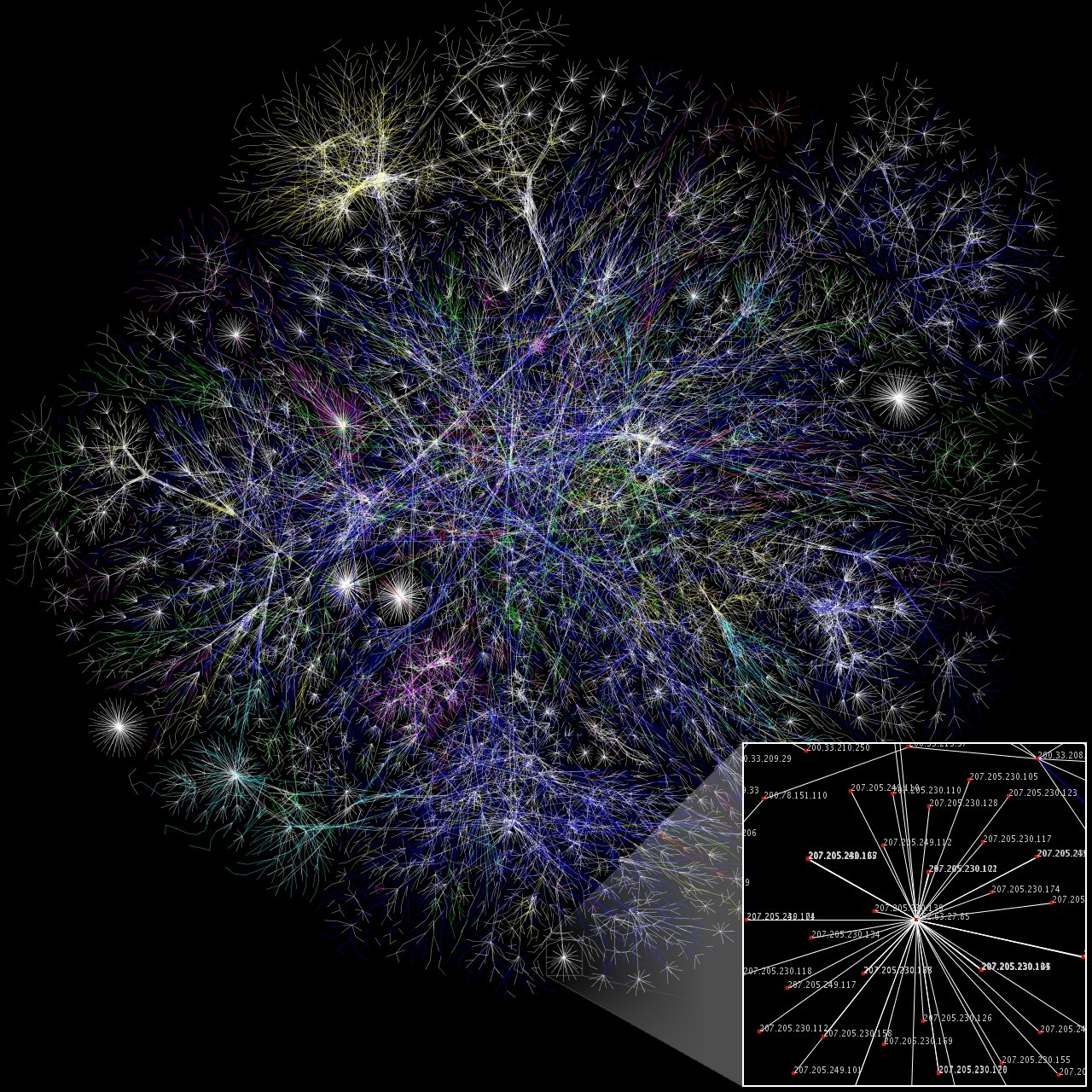
A visualization of internet routing paths. IRC was among the first protocols to connect strangers across this web in real time.

Here's something that will date you immediately: in the early 1990s, if you wanted to talk to strangers on the internet in real time, there was basically one option. Not a website. Not an app. A protocol called IRC, which stood for Internet Relay Chat. No graphics. No usernames with verified checkmarks. No algorithm deciding what you should see. Just text, typed into a client program, relayed through servers that anyone could set up.

By the year 2000, over a million people were connected to IRC simultaneously. Think about that number for a moment. The web itself wasn't even a decade old yet. Smartphones didn't exist. The idea that you could just open a program and talk to people from Japan, Australia, Brazil, right now, in real time, felt like genuinely powerful magic. And it was built on a protocol so straightforward that you could understand how it worked if someone explained it to you for five minutes.

The Finnish Accidental Breakthrough

IRC was created in August 1988 by a 23-year-old computer science student named Jarkko Oikarinen at the University of Oulu in Finland. He wasn't trying to change the internet. He was trying to improve something much smaller. The university had a system called MUT, short for MultiUser Talk, which let people on the same BBS system chat with each other. But it only worked on one machine. Oikarinen thought, why not make it work across multiple machines on the network.

He built the first IRC server on a machine called tolsun.oulu.fi. Released it. People started using it. And then something unexpected happened. By November 1988, just three months later, the protocol had spread across the entire internet. By mid-1989, there were roughly 40 IRC servers running worldwide. The thing had gone from university project to global network without anyone planning it that way.

What made IRC spread so fast wasn't hype. It wasn't funding or venture capital. Those things didn't exist in that context. It spread because the protocol was simple enough that other people could implement it, and it solved a real problem that a lot of people had. Which is to say, it was the opposite of how most internet services work now.

The Gulf War and the First Global Event

For most of its early years, IRC was a curiosity. Text-only chat for technical people, mostly developers and academics. You needed to know how to use a Unix command line. You needed to know IRC commands. It wasn't exactly mass market. And then, on January 16, 1991, something happened that changed how the internet reported the news.

The Gulf War began. And something extraordinary occurred on IRC.

When coalition forces began bombing Iraq, the television networks in the United States cut away from their regular programming to cover the attacks. But in the first week of the war, Saudi Arabia shut down radio and television broadcasts. The country was under a news blackout. No one outside Saudi Arabia was getting information. Except on IRC.

A user on IRC named Johan was in Kuwait. Or connected through Kuwait. The exact details are murky because this was 1991 and nobody was writing things down. But Johan was relaying live updates from what was happening on the ground. Real-time information. People who wanted to know what was actually going on weren't watching CNN or the BBC. They were on IRC, reading text being typed in by someone who was there.

For the first time, IRC had more than a few hundred concurrent users. It hit over 300 simultaneous users, which at the time felt enormous. The protocol held up. The servers didn't crash. And suddenly, a lot of people understood that this wasn't just a chat system for nerds. This was something that could matter.

The Network Wars

The problem with IRC was that it was decentralized by design. Anyone could set up a server. Anyone could connect their server to the network. Which sounds great in theory, until you realize that this meant no one actually controlled anything, so problems escalated fast.

By the early 1990s, the IRC network started fragmenting. Server operators would argue about how things should be run. Some wanted stricter controls. Others wanted to stay more open. In October 1992, someone took down a bunch of servers as part of some dispute nobody can quite explain anymore. When they came back online, the network had split. You had EFnet, which was the "original" network, and Undernet, which was the breakaway. Both claimed to be the real IRC.

This happened again. In 1996, EFnet split into EFnet and IRCnet, with the European servers going one way and US servers going another. Different philosophies about server operators and how the network should be managed led to different networks running the same protocol.

Then there was DALnet, which formed because people were sick of constant splits and lag and takeovers on the existing networks. The origin story is genuinely funny. A group of people were hanging out in a channel called #StarTrek and got tired of the drama. So they split off and created their own network. It grew to become one of the biggest.

Understanding why these splits happened requires understanding what made running IRC servers hard. Servers could be resource-intensive. They could crash. They could get compromised. And because there was no central authority, if a server operator decided to do something controversial, the only recourse was to split off and create a new network. This happened so often that it became almost routine. A server goes down. There's a dispute about how the network should be run. Someone decides to fork the protocol and start their own thing.

By 2002, you had probably a dozen major IRC networks. Each with different server configurations. Each with different bot capabilities. Each with different channel limits. Each with different moderation policies. Some networks allowed more automation. Some restricted bots heavily. Some had channels with thousands of users. Some networks were smaller and more curated. Pick your network based on what you wanted. It was fragmented but it worked.

The problem was always the same though. Network splits would happen. You'd get logged in one day and suddenly you couldn't see half your friends. They were on a different split of the network. Or you could see them but messages weren't getting through. The technical infrastructure was fragile. Every server was a single point of failure. The network was resilient in theory, decentralized by design, but in practice it kept fragmenting.

By the late 1990s, if you wanted to use IRC, you had to pick a network. EFnet. Undernet. IRCnet. DALnet. QuakeNet (which started as a network for Quake players but became enormous). Each had its own server list. Each had its own culture. Each had its own peak concurrent user count that they'd brag about. It was like parallel universes, all running the same protocol, all fundamentally unable to talk to each other.

The weirdest part is that this was fine. People understood it. You picked a network based on where your friends were or what communities you wanted to join. Nobody complained that you couldn't message someone on EFnet from Undernet. That was just how it worked. This is essentially what TikTok's algorithm did twenty years later, except instead of splitting into separate servers, they just showed you different feeds.

The Golden Age That Nobody Realized Was Golden

Between 2000 and 2005, IRC hit its absolute peak. Peak concurrent users across all networks was over a million people at any given moment. QuakeNet alone had over 240,000 people online simultaneously. There were entire communities living on IRC. People would log in and stay logged in for hours. Channels had bots that would do things. IRC had become a platform.

For gaming, IRC was everything. Clans organized matches over IRC. People ran tournaments through IRC channels. The esports infrastructure, before it was called esports, was built on IRC and people typing commands into bots.

The mIRC client was genuinely elegant for its time. You'd launch it and you'd get a window with a list of networks. Click on a network. Click on a channel. Boom, you're there. You're talking to people. And because it was Windows shareware, it was accessible. You could run it on any Windows machine. You didn't need to know how to use the command line. You didn't need to be technical. You just needed to know how to click buttons.

For people using Unix systems, the experience was different. You'd SSH into a server, usually one hosted by your ISP or your university, and you'd run an IRC client from the command line. BitchX was popular. So was ircII. These were much more technical to use but much more powerful once you understood them. You could configure everything. You could write scripts that would do things. You could automate your entire IRC experience if you knew what you were doing.

And then there were the bots. Bots on IRC were legitimate pieces of infrastructure. A bot would manage channel modes, kick troublemakers, maintain channel topics, store information, run games, anything you could imagine. Bots like Eggdrop became legendary. People would spend hours configuring their bots, writing scripts, making them do useful things. It was like having a little robot hanging out in your channel, following whatever rules you told it to follow.

For open source development, IRC was the water cooler. Linux kernel developers hung out in IRC channels. Free software communities coordinated on IRC. If you wanted to contribute to a major open source project in the 1990s, you needed to be on IRC.

The dominant Windows client was mIRC, which was shareware. You could use it for 30 days free, and then it would nag you to pay something like 20 dollars. A lot of people paid. It became one of the most successful shareware programs ever. The author, Khaled Mardam-Bey, maintained it for decades and still maintains it now, which is genuinely remarkable for a piece of software from that era.

On Unix systems, there were clients like ircII and BitchX and ircle on the Mac. The fragmentation was real, but people didn't really care. You got to know your client and you used it.

The Decline: Two Turning Points

ChatZilla IRC client showing a typical chat session
An IRC session in ChatZilla. The text-based interface was both IRC's strength and, eventually, its limitation.

IRC didn't die overnight. It had two major turning points that fractured it.

The first was the rise of web-based chat. As broadband became standard and web technology got better, people realized you could just log into a website and chat. You didn't need to install a client. You didn't need to remember commands. You could do it on your phone browser, eventually. Slowly, communities started moving to web platforms. Then to proprietary platforms. Then to Discord.

Discord launched in 2015. It was IRC with a better UI, better voice integration, and, most importantly, it was one unified network that you didn't have to configure. There were no server splits because Discord Inc. owned all the servers. There were no network fragments because everyone was on the same platform. It was the logical conclusion of what IRC always wanted to be but couldn't quite achieve because of its own architecture.

The second turning point was more dramatic. In May 2021, Libera Chat, which had become the largest IRC network, underwent a hostile takeover. The company that owned the domain essentially seized control of the platform. The staff all resigned. The communities, which had been there for decades, had to leave. They migrated to a new network called Libera Chat that was set up by the people who had left. It was basically a refugee crisis in real time, and it exposed something that people had been able to ignore: IRC networks had concentrated power in whoever controlled the domain and the servers. You could own a piece of the network, but you didn't own your community.

Between 2003 and 2012, IRC had lost about 60 percent of its users. By the 2020s, it had become something people used if they were in certain niche communities, certain open source projects, certain gaming clans. But the general public had moved on. The Rust programming language community, which had a significant presence on IRC, officially migrated to Discord in 2019. Mozilla deprecated IRC support the same year.

What IRC Actually Was

The thing about IRC is that it was never trying to be a consumer product. It was a protocol. A set of rules for how machines and clients should talk to each other. And because it was just a protocol, anyone could build anything on top of it. You could build clients with whatever UI you wanted. You could build bots that did specific tasks. You could build networks with specific rules and cultures. It was extensible and hackable in a way that closed platforms never could be.

The problem with that approach is that it means you're constantly dealing with fragmentation. Different networks. Different clients. Different conventions for the same basic thing. From a platform owner's perspective, this is chaos. From a user's perspective, it's freedom. And the internet chose differently. The internet chose platforms.

Discord is essentially modern IRC, but owned by a company. Slack is modern IRC for businesses. Both of them copied IRC's core idea: channels, direct messages, text-based communication, bots that can do things. But they wrapped it in a unified platform that someone controls. And for the general public, that was better. Cleaner. Simpler. Less fragmented.

But something was lost. IRC was genuinely weird. There were real communities there. You could create a channel and there was no algorithm deciding who saw it. If you wanted to run a network, you could. If you wanted to fork the protocol and do something different, you could. It was built on the assumption that the internet was something people would tinker with and modify and improve. Not something they would consume.

That assumption turned out to be too optimistic.

The Freenode Disaster and What It Meant

When Freenode, the other massive IRC network, went through the hostile takeover in May 2021, it was genuinely shocking. The network had over 200,000 concurrent users. Decades of accumulated communities. The open source infrastructure of the internet essentially running on it. And then it was gone because someone owned the domain and decided to take it back.

The staff migrated everyone to Libera Chat. But not everyone moved. Some people were on other networks. Some people had drifted to Discord already. Some people just gave up on IRC entirely. The network never recovered to its previous size.

What happened to Freenode and Libera is the exact opposite of how IRC was supposed to work. You weren't supposed to lose everything because one person decided to take over a domain. The whole point of a decentralized network was that it was supposed to be resilient. But in practice, decentralization meant that anyone could disrupt everything by controlling one key piece.

Where IRC Is Now

IRC still exists. You can go find communities on various networks. The old networks like EFnet and Undernet still have active users. Libera Chat rebuilt and has communities. There are smaller networks with specific communities. Open source projects that care about decentralization still use IRC. The Gentoo Linux community basically lives on IRC.

But these are niche communities now. The casual user, the person who wants to chat with friends online, is on Discord or Slack or WhatsApp or TikTok or any of a hundred other platforms. They're not thinking about IRC. They might not even know it exists.

And that's probably fine. IRC was a tool for a specific era of the internet. An era when the internet was something you built, not something you consumed. When protocols mattered more than platforms. When you expected to tinker with things. That era is over.

But if you use Discord, you're using something that is philosophically descended from IRC. If you use Slack, you're using modern IRC for work. The DNA is there. The basic idea, that people should be able to talk to each other in real time in organized channels, was so good that it survived the transition to closed, proprietary platforms. IRC didn't die so much as it evolved into something that didn't need to fragment because someone owned the whole thing.

Which, if you think about it, is exactly what the internet was supposed to prevent. But here we are.

FAQ

What does IRC stand for? Internet Relay Chat. It's a protocol, not a specific service, which is why it's confusing to people used to thinking about internet communication through apps.

Can I still use IRC? Yes. It's still operational. You can find various IRC networks and connect using a client like HexChat or Irssi. It's just not where the general population is anymore.

Is IRC secure? Not by modern standards. Messages were transmitted in plain text and could be read by anyone on the network. Modern chat applications use encryption, which IRC does not inherently support, though some servers and clients have added TLS support.

Why did Discord win instead of IRC continuing to evolve? Discord offered a unified platform, better UI, integrated voice and video, and didn't require technical knowledge to use. IRC required you to choose a network, install a client, and understand how everything connected. For most people, that friction was enough to switch.

Did Discord copy IRC? Not exactly. Discord was designed as a modern alternative with a very similar feature set (channels, direct messages, communities). The philosophy is different though. Discord is centralized and owned by a company. IRC was decentralized by design.

What was the most popular IRC network? QuakeNet was the largest by concurrent users at its peak, with over 240,000 simultaneous users. But Freenode was arguably more important to internet infrastructure because of its role in open source communities.

Is IRC dead? Not dead, but definitely a niche product now. It peaked between 2000 and 2005. It still has dedicated users, but it's not where new people are learning to communicate online.

๐Ÿ“– What Happened to IRC, the Chat Protocol That Built the Internet
_ โ–ก ร—
← Back

What Happened to IRC, the Chat Protocol That Built the Internet

2026-04-09 by 404 Memory Found
Visualization of internet routing paths, representing the network infrastructure IRC helped pioneer
A visualization of internet routing paths. IRC was among the first protocols to connect strangers across this web in real time.

Here's something that will date you immediately: in the early 1990s, if you wanted to talk to strangers on the internet in real time, there was basically one option. Not a website. Not an app. A protocol called IRC, which stood for Internet Relay Chat. No graphics. No usernames with verified checkmarks. No algorithm deciding what you should see. Just text, typed into a client program, relayed through servers that anyone could set up.

By the year 2000, over a million people were connected to IRC simultaneously. Think about that number for a moment. The web itself wasn't even a decade old yet. Smartphones didn't exist. The idea that you could just open a program and talk to people from Japan, Australia, Brazil, right now, in real time, felt like genuinely powerful magic. And it was built on a protocol so straightforward that you could understand how it worked if someone explained it to you for five minutes.

The Finnish Accidental Breakthrough

IRC was created in August 1988 by a 23-year-old computer science student named Jarkko Oikarinen at the University of Oulu in Finland. He wasn't trying to change the internet. He was trying to improve something much smaller. The university had a system called MUT, short for MultiUser Talk, which let people on the same BBS system chat with each other. But it only worked on one machine. Oikarinen thought, why not make it work across multiple machines on the network.

He built the first IRC server on a machine called tolsun.oulu.fi. Released it. People started using it. And then something unexpected happened. By November 1988, just three months later, the protocol had spread across the entire internet. By mid-1989, there were roughly 40 IRC servers running worldwide. The thing had gone from university project to global network without anyone planning it that way.

What made IRC spread so fast wasn't hype. It wasn't funding or venture capital. Those things didn't exist in that context. It spread because the protocol was simple enough that other people could implement it, and it solved a real problem that a lot of people had. Which is to say, it was the opposite of how most internet services work now.

The Gulf War and the First Global Event

For most of its early years, IRC was a curiosity. Text-only chat for technical people, mostly developers and academics. You needed to know how to use a Unix command line. You needed to know IRC commands. It wasn't exactly mass market. And then, on January 16, 1991, something happened that changed how the internet reported the news.

The Gulf War began. And something extraordinary occurred on IRC.

When coalition forces began bombing Iraq, the television networks in the United States cut away from their regular programming to cover the attacks. But in the first week of the war, Saudi Arabia shut down radio and television broadcasts. The country was under a news blackout. No one outside Saudi Arabia was getting information. Except on IRC.

A user on IRC named Johan was in Kuwait. Or connected through Kuwait. The exact details are murky because this was 1991 and nobody was writing things down. But Johan was relaying live updates from what was happening on the ground. Real-time information. People who wanted to know what was actually going on weren't watching CNN or the BBC. They were on IRC, reading text being typed in by someone who was there.

For the first time, IRC had more than a few hundred concurrent users. It hit over 300 simultaneous users, which at the time felt enormous. The protocol held up. The servers didn't crash. And suddenly, a lot of people understood that this wasn't just a chat system for nerds. This was something that could matter.

The Network Wars

The problem with IRC was that it was decentralized by design. Anyone could set up a server. Anyone could connect their server to the network. Which sounds great in theory, until you realize that this meant no one actually controlled anything, so problems escalated fast.

By the early 1990s, the IRC network started fragmenting. Server operators would argue about how things should be run. Some wanted stricter controls. Others wanted to stay more open. In October 1992, someone took down a bunch of servers as part of some dispute nobody can quite explain anymore. When they came back online, the network had split. You had EFnet, which was the "original" network, and Undernet, which was the breakaway. Both claimed to be the real IRC.

This happened again. In 1996, EFnet split into EFnet and IRCnet, with the European servers going one way and US servers going another. Different philosophies about server operators and how the network should be managed led to different networks running the same protocol.

Then there was DALnet, which formed because people were sick of constant splits and lag and takeovers on the existing networks. The origin story is genuinely funny. A group of people were hanging out in a channel called #StarTrek and got tired of the drama. So they split off and created their own network. It grew to become one of the biggest.

Understanding why these splits happened requires understanding what made running IRC servers hard. Servers could be resource-intensive. They could crash. They could get compromised. And because there was no central authority, if a server operator decided to do something controversial, the only recourse was to split off and create a new network. This happened so often that it became almost routine. A server goes down. There's a dispute about how the network should be run. Someone decides to fork the protocol and start their own thing.

By 2002, you had probably a dozen major IRC networks. Each with different server configurations. Each with different bot capabilities. Each with different channel limits. Each with different moderation policies. Some networks allowed more automation. Some restricted bots heavily. Some had channels with thousands of users. Some networks were smaller and more curated. Pick your network based on what you wanted. It was fragmented but it worked.

The problem was always the same though. Network splits would happen. You'd get logged in one day and suddenly you couldn't see half your friends. They were on a different split of the network. Or you could see them but messages weren't getting through. The technical infrastructure was fragile. Every server was a single point of failure. The network was resilient in theory, decentralized by design, but in practice it kept fragmenting.

By the late 1990s, if you wanted to use IRC, you had to pick a network. EFnet. Undernet. IRCnet. DALnet. QuakeNet (which started as a network for Quake players but became enormous). Each had its own server list. Each had its own culture. Each had its own peak concurrent user count that they'd brag about. It was like parallel universes, all running the same protocol, all fundamentally unable to talk to each other.

The weirdest part is that this was fine. People understood it. You picked a network based on where your friends were or what communities you wanted to join. Nobody complained that you couldn't message someone on EFnet from Undernet. That was just how it worked. This is essentially what TikTok's algorithm did twenty years later, except instead of splitting into separate servers, they just showed you different feeds.

The Golden Age That Nobody Realized Was Golden

Between 2000 and 2005, IRC hit its absolute peak. Peak concurrent users across all networks was over a million people at any given moment. QuakeNet alone had over 240,000 people online simultaneously. There were entire communities living on IRC. People would log in and stay logged in for hours. Channels had bots that would do things. IRC had become a platform.

For gaming, IRC was everything. Clans organized matches over IRC. People ran tournaments through IRC channels. The esports infrastructure, before it was called esports, was built on IRC and people typing commands into bots.

The mIRC client was genuinely elegant for its time. You'd launch it and you'd get a window with a list of networks. Click on a network. Click on a channel. Boom, you're there. You're talking to people. And because it was Windows shareware, it was accessible. You could run it on any Windows machine. You didn't need to know how to use the command line. You didn't need to be technical. You just needed to know how to click buttons.

For people using Unix systems, the experience was different. You'd SSH into a server, usually one hosted by your ISP or your university, and you'd run an IRC client from the command line. BitchX was popular. So was ircII. These were much more technical to use but much more powerful once you understood them. You could configure everything. You could write scripts that would do things. You could automate your entire IRC experience if you knew what you were doing.

And then there were the bots. Bots on IRC were legitimate pieces of infrastructure. A bot would manage channel modes, kick troublemakers, maintain channel topics, store information, run games, anything you could imagine. Bots like Eggdrop became legendary. People would spend hours configuring their bots, writing scripts, making them do useful things. It was like having a little robot hanging out in your channel, following whatever rules you told it to follow.

For open source development, IRC was the water cooler. Linux kernel developers hung out in IRC channels. Free software communities coordinated on IRC. If you wanted to contribute to a major open source project in the 1990s, you needed to be on IRC.

The dominant Windows client was mIRC, which was shareware. You could use it for 30 days free, and then it would nag you to pay something like 20 dollars. A lot of people paid. It became one of the most successful shareware programs ever. The author, Khaled Mardam-Bey, maintained it for decades and still maintains it now, which is genuinely remarkable for a piece of software from that era.

On Unix systems, there were clients like ircII and BitchX and ircle on the Mac. The fragmentation was real, but people didn't really care. You got to know your client and you used it.

The Decline: Two Turning Points

ChatZilla IRC client showing a typical chat session
An IRC session in ChatZilla. The text-based interface was both IRC's strength and, eventually, its limitation.

IRC didn't die overnight. It had two major turning points that fractured it.

The first was the rise of web-based chat. As broadband became standard and web technology got better, people realized you could just log into a website and chat. You didn't need to install a client. You didn't need to remember commands. You could do it on your phone browser, eventually. Slowly, communities started moving to web platforms. Then to proprietary platforms. Then to Discord.

Discord launched in 2015. It was IRC with a better UI, better voice integration, and, most importantly, it was one unified network that you didn't have to configure. There were no server splits because Discord Inc. owned all the servers. There were no network fragments because everyone was on the same platform. It was the logical conclusion of what IRC always wanted to be but couldn't quite achieve because of its own architecture.

The second turning point was more dramatic. In May 2021, Libera Chat, which had become the largest IRC network, underwent a hostile takeover. The company that owned the domain essentially seized control of the platform. The staff all resigned. The communities, which had been there for decades, had to leave. They migrated to a new network called Libera Chat that was set up by the people who had left. It was basically a refugee crisis in real time, and it exposed something that people had been able to ignore: IRC networks had concentrated power in whoever controlled the domain and the servers. You could own a piece of the network, but you didn't own your community.

Between 2003 and 2012, IRC had lost about 60 percent of its users. By the 2020s, it had become something people used if they were in certain niche communities, certain open source projects, certain gaming clans. But the general public had moved on. The Rust programming language community, which had a significant presence on IRC, officially migrated to Discord in 2019. Mozilla deprecated IRC support the same year.

What IRC Actually Was

The thing about IRC is that it was never trying to be a consumer product. It was a protocol. A set of rules for how machines and clients should talk to each other. And because it was just a protocol, anyone could build anything on top of it. You could build clients with whatever UI you wanted. You could build bots that did specific tasks. You could build networks with specific rules and cultures. It was extensible and hackable in a way that closed platforms never could be.

The problem with that approach is that it means you're constantly dealing with fragmentation. Different networks. Different clients. Different conventions for the same basic thing. From a platform owner's perspective, this is chaos. From a user's perspective, it's freedom. And the internet chose differently. The internet chose platforms.

Discord is essentially modern IRC, but owned by a company. Slack is modern IRC for businesses. Both of them copied IRC's core idea: channels, direct messages, text-based communication, bots that can do things. But they wrapped it in a unified platform that someone controls. And for the general public, that was better. Cleaner. Simpler. Less fragmented.

But something was lost. IRC was genuinely weird. There were real communities there. You could create a channel and there was no algorithm deciding who saw it. If you wanted to run a network, you could. If you wanted to fork the protocol and do something different, you could. It was built on the assumption that the internet was something people would tinker with and modify and improve. Not something they would consume.

That assumption turned out to be too optimistic.

The Freenode Disaster and What It Meant

When Freenode, the other massive IRC network, went through the hostile takeover in May 2021, it was genuinely shocking. The network had over 200,000 concurrent users. Decades of accumulated communities. The open source infrastructure of the internet essentially running on it. And then it was gone because someone owned the domain and decided to take it back.

The staff migrated everyone to Libera Chat. But not everyone moved. Some people were on other networks. Some people had drifted to Discord already. Some people just gave up on IRC entirely. The network never recovered to its previous size.

What happened to Freenode and Libera is the exact opposite of how IRC was supposed to work. You weren't supposed to lose everything because one person decided to take over a domain. The whole point of a decentralized network was that it was supposed to be resilient. But in practice, decentralization meant that anyone could disrupt everything by controlling one key piece.

Where IRC Is Now

IRC still exists. You can go find communities on various networks. The old networks like EFnet and Undernet still have active users. Libera Chat rebuilt and has communities. There are smaller networks with specific communities. Open source projects that care about decentralization still use IRC. The Gentoo Linux community basically lives on IRC.

But these are niche communities now. The casual user, the person who wants to chat with friends online, is on Discord or Slack or WhatsApp or TikTok or any of a hundred other platforms. They're not thinking about IRC. They might not even know it exists.

And that's probably fine. IRC was a tool for a specific era of the internet. An era when the internet was something you built, not something you consumed. When protocols mattered more than platforms. When you expected to tinker with things. That era is over.

But if you use Discord, you're using something that is philosophically descended from IRC. If you use Slack, you're using modern IRC for work. The DNA is there. The basic idea, that people should be able to talk to each other in real time in organized channels, was so good that it survived the transition to closed, proprietary platforms. IRC didn't die so much as it evolved into something that didn't need to fragment because someone owned the whole thing.

Which, if you think about it, is exactly what the internet was supposed to prevent. But here we are.

FAQ

What does IRC stand for? Internet Relay Chat. It's a protocol, not a specific service, which is why it's confusing to people used to thinking about internet communication through apps.

Can I still use IRC? Yes. It's still operational. You can find various IRC networks and connect using a client like HexChat or Irssi. It's just not where the general population is anymore.

Is IRC secure? Not by modern standards. Messages were transmitted in plain text and could be read by anyone on the network. Modern chat applications use encryption, which IRC does not inherently support, though some servers and clients have added TLS support.

Why did Discord win instead of IRC continuing to evolve? Discord offered a unified platform, better UI, integrated voice and video, and didn't require technical knowledge to use. IRC required you to choose a network, install a client, and understand how everything connected. For most people, that friction was enough to switch.

Did Discord copy IRC? Not exactly. Discord was designed as a modern alternative with a very similar feature set (channels, direct messages, communities). The philosophy is different though. Discord is centralized and owned by a company. IRC was decentralized by design.

What was the most popular IRC network? QuakeNet was the largest by concurrent users at its peak, with over 240,000 simultaneous users. But Freenode was arguably more important to internet infrastructure because of its role in open source communities.

Is IRC dead? Not dead, but definitely a niche product now. It peaked between 2000 and 2005. It still has dedicated users, but it's not where new people are learning to communicate online.

๐Ÿ“– What Happened to IRC, the Chat Protocol That Built the Internet
Visualization of internet routing paths, representing the network infrastructure IRC helped pioneer
A visualization of internet routing paths. IRC was among the first protocols to connect strangers across this web in real time.

Here's something that will date you immediately: in the early 1990s, if you wanted to talk to strangers on the internet in real time, there was basically one option. Not a website. Not an app. A protocol called IRC, which stood for Internet Relay Chat. No graphics. No usernames with verified checkmarks. No algorithm deciding what you should see. Just text, typed into a client program, relayed through servers that anyone could set up.

By the year 2000, over a million people were connected to IRC simultaneously. Think about that number for a moment. The web itself wasn't even a decade old yet. Smartphones didn't exist. The idea that you could just open a program and talk to people from Japan, Australia, Brazil, right now, in real time, felt like genuinely powerful magic. And it was built on a protocol so straightforward that you could understand how it worked if someone explained it to you for five minutes.

The Finnish Accidental Breakthrough

IRC was created in August 1988 by a 23-year-old computer science student named Jarkko Oikarinen at the University of Oulu in Finland. He wasn't trying to change the internet. He was trying to improve something much smaller. The university had a system called MUT, short for MultiUser Talk, which let people on the same BBS system chat with each other. But it only worked on one machine. Oikarinen thought, why not make it work across multiple machines on the network.

He built the first IRC server on a machine called tolsun.oulu.fi. Released it. People started using it. And then something unexpected happened. By November 1988, just three months later, the protocol had spread across the entire internet. By mid-1989, there were roughly 40 IRC servers running worldwide. The thing had gone from university project to global network without anyone planning it that way.

What made IRC spread so fast wasn't hype. It wasn't funding or venture capital. Those things didn't exist in that context. It spread because the protocol was simple enough that other people could implement it, and it solved a real problem that a lot of people had. Which is to say, it was the opposite of how most internet services work now.

The Gulf War and the First Global Event

For most of its early years, IRC was a curiosity. Text-only chat for technical people, mostly developers and academics. You needed to know how to use a Unix command line. You needed to know IRC commands. It wasn't exactly mass market. And then, on January 16, 1991, something happened that changed how the internet reported the news.

The Gulf War began. And something extraordinary occurred on IRC.

When coalition forces began bombing Iraq, the television networks in the United States cut away from their regular programming to cover the attacks. But in the first week of the war, Saudi Arabia shut down radio and television broadcasts. The country was under a news blackout. No one outside Saudi Arabia was getting information. Except on IRC.

A user on IRC named Johan was in Kuwait. Or connected through Kuwait. The exact details are murky because this was 1991 and nobody was writing things down. But Johan was relaying live updates from what was happening on the ground. Real-time information. People who wanted to know what was actually going on weren't watching CNN or the BBC. They were on IRC, reading text being typed in by someone who was there.

For the first time, IRC had more than a few hundred concurrent users. It hit over 300 simultaneous users, which at the time felt enormous. The protocol held up. The servers didn't crash. And suddenly, a lot of people understood that this wasn't just a chat system for nerds. This was something that could matter.

The Network Wars

The problem with IRC was that it was decentralized by design. Anyone could set up a server. Anyone could connect their server to the network. Which sounds great in theory, until you realize that this meant no one actually controlled anything, so problems escalated fast.

By the early 1990s, the IRC network started fragmenting. Server operators would argue about how things should be run. Some wanted stricter controls. Others wanted to stay more open. In October 1992, someone took down a bunch of servers as part of some dispute nobody can quite explain anymore. When they came back online, the network had split. You had EFnet, which was the "original" network, and Undernet, which was the breakaway. Both claimed to be the real IRC.

This happened again. In 1996, EFnet split into EFnet and IRCnet, with the European servers going one way and US servers going another. Different philosophies about server operators and how the network should be managed led to different networks running the same protocol.

Then there was DALnet, which formed because people were sick of constant splits and lag and takeovers on the existing networks. The origin story is genuinely funny. A group of people were hanging out in a channel called #StarTrek and got tired of the drama. So they split off and created their own network. It grew to become one of the biggest.

Understanding why these splits happened requires understanding what made running IRC servers hard. Servers could be resource-intensive. They could crash. They could get compromised. And because there was no central authority, if a server operator decided to do something controversial, the only recourse was to split off and create a new network. This happened so often that it became almost routine. A server goes down. There's a dispute about how the network should be run. Someone decides to fork the protocol and start their own thing.

By 2002, you had probably a dozen major IRC networks. Each with different server configurations. Each with different bot capabilities. Each with different channel limits. Each with different moderation policies. Some networks allowed more automation. Some restricted bots heavily. Some had channels with thousands of users. Some networks were smaller and more curated. Pick your network based on what you wanted. It was fragmented but it worked.

The problem was always the same though. Network splits would happen. You'd get logged in one day and suddenly you couldn't see half your friends. They were on a different split of the network. Or you could see them but messages weren't getting through. The technical infrastructure was fragile. Every server was a single point of failure. The network was resilient in theory, decentralized by design, but in practice it kept fragmenting.

By the late 1990s, if you wanted to use IRC, you had to pick a network. EFnet. Undernet. IRCnet. DALnet. QuakeNet (which started as a network for Quake players but became enormous). Each had its own server list. Each had its own culture. Each had its own peak concurrent user count that they'd brag about. It was like parallel universes, all running the same protocol, all fundamentally unable to talk to each other.

The weirdest part is that this was fine. People understood it. You picked a network based on where your friends were or what communities you wanted to join. Nobody complained that you couldn't message someone on EFnet from Undernet. That was just how it worked. This is essentially what TikTok's algorithm did twenty years later, except instead of splitting into separate servers, they just showed you different feeds.

The Golden Age That Nobody Realized Was Golden

Between 2000 and 2005, IRC hit its absolute peak. Peak concurrent users across all networks was over a million people at any given moment. QuakeNet alone had over 240,000 people online simultaneously. There were entire communities living on IRC. People would log in and stay logged in for hours. Channels had bots that would do things. IRC had become a platform.

For gaming, IRC was everything. Clans organized matches over IRC. People ran tournaments through IRC channels. The esports infrastructure, before it was called esports, was built on IRC and people typing commands into bots.

The mIRC client was genuinely elegant for its time. You'd launch it and you'd get a window with a list of networks. Click on a network. Click on a channel. Boom, you're there. You're talking to people. And because it was Windows shareware, it was accessible. You could run it on any Windows machine. You didn't need to know how to use the command line. You didn't need to be technical. You just needed to know how to click buttons.

For people using Unix systems, the experience was different. You'd SSH into a server, usually one hosted by your ISP or your university, and you'd run an IRC client from the command line. BitchX was popular. So was ircII. These were much more technical to use but much more powerful once you understood them. You could configure everything. You could write scripts that would do things. You could automate your entire IRC experience if you knew what you were doing.

And then there were the bots. Bots on IRC were legitimate pieces of infrastructure. A bot would manage channel modes, kick troublemakers, maintain channel topics, store information, run games, anything you could imagine. Bots like Eggdrop became legendary. People would spend hours configuring their bots, writing scripts, making them do useful things. It was like having a little robot hanging out in your channel, following whatever rules you told it to follow.

For open source development, IRC was the water cooler. Linux kernel developers hung out in IRC channels. Free software communities coordinated on IRC. If you wanted to contribute to a major open source project in the 1990s, you needed to be on IRC.

The dominant Windows client was mIRC, which was shareware. You could use it for 30 days free, and then it would nag you to pay something like 20 dollars. A lot of people paid. It became one of the most successful shareware programs ever. The author, Khaled Mardam-Bey, maintained it for decades and still maintains it now, which is genuinely remarkable for a piece of software from that era.

On Unix systems, there were clients like ircII and BitchX and ircle on the Mac. The fragmentation was real, but people didn't really care. You got to know your client and you used it.

The Decline: Two Turning Points

ChatZilla IRC client showing a typical chat session
An IRC session in ChatZilla. The text-based interface was both IRC's strength and, eventually, its limitation.

IRC didn't die overnight. It had two major turning points that fractured it.

The first was the rise of web-based chat. As broadband became standard and web technology got better, people realized you could just log into a website and chat. You didn't need to install a client. You didn't need to remember commands. You could do it on your phone browser, eventually. Slowly, communities started moving to web platforms. Then to proprietary platforms. Then to Discord.

Discord launched in 2015. It was IRC with a better UI, better voice integration, and, most importantly, it was one unified network that you didn't have to configure. There were no server splits because Discord Inc. owned all the servers. There were no network fragments because everyone was on the same platform. It was the logical conclusion of what IRC always wanted to be but couldn't quite achieve because of its own architecture.

The second turning point was more dramatic. In May 2021, Libera Chat, which had become the largest IRC network, underwent a hostile takeover. The company that owned the domain essentially seized control of the platform. The staff all resigned. The communities, which had been there for decades, had to leave. They migrated to a new network called Libera Chat that was set up by the people who had left. It was basically a refugee crisis in real time, and it exposed something that people had been able to ignore: IRC networks had concentrated power in whoever controlled the domain and the servers. You could own a piece of the network, but you didn't own your community.

Between 2003 and 2012, IRC had lost about 60 percent of its users. By the 2020s, it had become something people used if they were in certain niche communities, certain open source projects, certain gaming clans. But the general public had moved on. The Rust programming language community, which had a significant presence on IRC, officially migrated to Discord in 2019. Mozilla deprecated IRC support the same year.

What IRC Actually Was

The thing about IRC is that it was never trying to be a consumer product. It was a protocol. A set of rules for how machines and clients should talk to each other. And because it was just a protocol, anyone could build anything on top of it. You could build clients with whatever UI you wanted. You could build bots that did specific tasks. You could build networks with specific rules and cultures. It was extensible and hackable in a way that closed platforms never could be.

The problem with that approach is that it means you're constantly dealing with fragmentation. Different networks. Different clients. Different conventions for the same basic thing. From a platform owner's perspective, this is chaos. From a user's perspective, it's freedom. And the internet chose differently. The internet chose platforms.

Discord is essentially modern IRC, but owned by a company. Slack is modern IRC for businesses. Both of them copied IRC's core idea: channels, direct messages, text-based communication, bots that can do things. But they wrapped it in a unified platform that someone controls. And for the general public, that was better. Cleaner. Simpler. Less fragmented.

But something was lost. IRC was genuinely weird. There were real communities there. You could create a channel and there was no algorithm deciding who saw it. If you wanted to run a network, you could. If you wanted to fork the protocol and do something different, you could. It was built on the assumption that the internet was something people would tinker with and modify and improve. Not something they would consume.

That assumption turned out to be too optimistic.

The Freenode Disaster and What It Meant

When Freenode, the other massive IRC network, went through the hostile takeover in May 2021, it was genuinely shocking. The network had over 200,000 concurrent users. Decades of accumulated communities. The open source infrastructure of the internet essentially running on it. And then it was gone because someone owned the domain and decided to take it back.

The staff migrated everyone to Libera Chat. But not everyone moved. Some people were on other networks. Some people had drifted to Discord already. Some people just gave up on IRC entirely. The network never recovered to its previous size.

What happened to Freenode and Libera is the exact opposite of how IRC was supposed to work. You weren't supposed to lose everything because one person decided to take over a domain. The whole point of a decentralized network was that it was supposed to be resilient. But in practice, decentralization meant that anyone could disrupt everything by controlling one key piece.

Where IRC Is Now

IRC still exists. You can go find communities on various networks. The old networks like EFnet and Undernet still have active users. Libera Chat rebuilt and has communities. There are smaller networks with specific communities. Open source projects that care about decentralization still use IRC. The Gentoo Linux community basically lives on IRC.

But these are niche communities now. The casual user, the person who wants to chat with friends online, is on Discord or Slack or WhatsApp or TikTok or any of a hundred other platforms. They're not thinking about IRC. They might not even know it exists.

And that's probably fine. IRC was a tool for a specific era of the internet. An era when the internet was something you built, not something you consumed. When protocols mattered more than platforms. When you expected to tinker with things. That era is over.

But if you use Discord, you're using something that is philosophically descended from IRC. If you use Slack, you're using modern IRC for work. The DNA is there. The basic idea, that people should be able to talk to each other in real time in organized channels, was so good that it survived the transition to closed, proprietary platforms. IRC didn't die so much as it evolved into something that didn't need to fragment because someone owned the whole thing.

Which, if you think about it, is exactly what the internet was supposed to prevent. But here we are.

FAQ

What does IRC stand for? Internet Relay Chat. It's a protocol, not a specific service, which is why it's confusing to people used to thinking about internet communication through apps.

Can I still use IRC? Yes. It's still operational. You can find various IRC networks and connect using a client like HexChat or Irssi. It's just not where the general population is anymore.

Is IRC secure? Not by modern standards. Messages were transmitted in plain text and could be read by anyone on the network. Modern chat applications use encryption, which IRC does not inherently support, though some servers and clients have added TLS support.

Why did Discord win instead of IRC continuing to evolve? Discord offered a unified platform, better UI, integrated voice and video, and didn't require technical knowledge to use. IRC required you to choose a network, install a client, and understand how everything connected. For most people, that friction was enough to switch.

Did Discord copy IRC? Not exactly. Discord was designed as a modern alternative with a very similar feature set (channels, direct messages, communities). The philosophy is different though. Discord is centralized and owned by a company. IRC was decentralized by design.

What was the most popular IRC network? QuakeNet was the largest by concurrent users at its peak, with over 240,000 simultaneous users. But Freenode was arguably more important to internet infrastructure because of its role in open source communities.

Is IRC dead? Not dead, but definitely a niche product now. It peaked between 2000 and 2005. It still has dedicated users, but it's not where new people are learning to communicate online.

00:00