How a British record chain got a foothold on Sunset Boulevard
Virgin Megastore opened its first American store in 1992, on Sunset Boulevard in Los Angeles.
The format came straight from London. One enormous room, hundreds of thousands of titles, listening posts, and clerks who would argue about a record instead of just scanning it.
US music retail in 1992 was already crowded. Tower Records held the West Coast, mall chains such as Sam Goody held everywhere else, and discount stores were using compact discs as loss leaders to pull shoppers through the door.
Virgin's answer was size and late hours. A megastore was not built to be the cheapest place to buy an album. It was built to be the place a visitor walked into because the sign was enormous and the doors stayed open past midnight.
That worked for a decade. Virgin Megastore reached 23 US stores by 2002, and those stores took in about $230 million a year, the Associated Press reported in 2009. It was the last national music chain of that size to expand into America rather than shrink inside it.
Why the Times Square store carried the whole chain
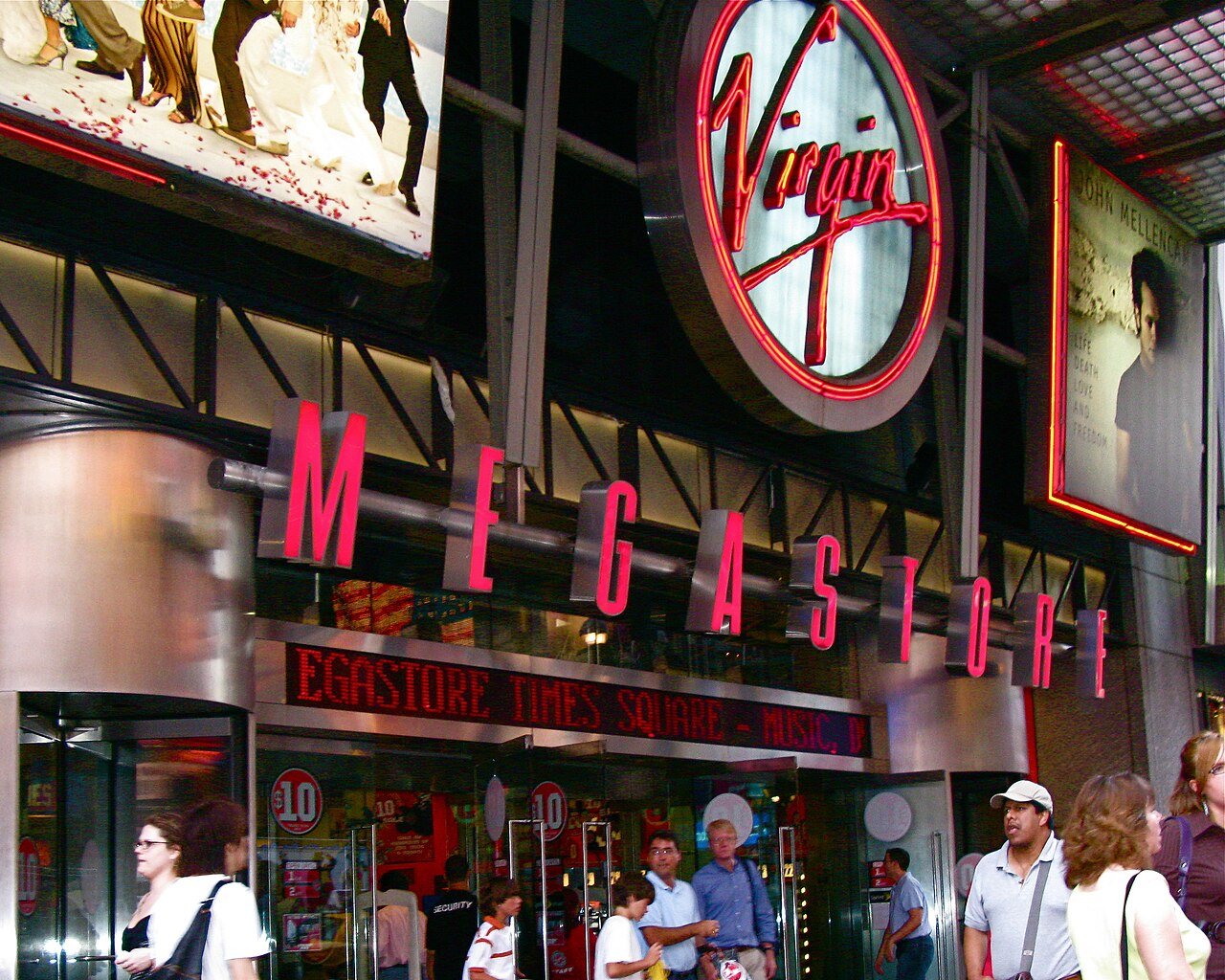
The flagship at 1540 Broadway was the business. Billboard reported in June 2008 that the store ran to about 65,000 square feet and that, on Reuters' figures, it had turned $55 million of sales into roughly $6 million of profit the year before.
That had little to do with being a good record shop. The store sat in the densest tourist corridor in the country, stayed open late, and carried a sign visible from blocks away.
It was also a physical argument in a fight the industry was losing. Napster arrived in 1999 and the iTunes Store in 2003, and by 2008 a shopper who wanted one song did not have to walk into a building at all.
Even so, the six stores still trading in 2009 were taking in roughly $170 million a year between them, down from $230 million at the 2002 peak, according to the Associated Press. That is a chain shrinking, not a chain failing.
Why two real estate firms bought a profitable record chain
In 2007 the US arm of the business, Virgin Entertainment Group North America, was bought by Related Companies and Vornado Realty Trust. Neither company was in the music business.
The reason was rent. Virgin had signed long leases in the 1990s, before Times Square became one of the most expensive retail addresses in the world, and it was still paying 1990s money.
Sandeep Mathrani, then Vornado's executive vice president for retail real estate, said so plainly. "We bought the Virgin business to wind it down to get a hold of the real estate," he told Reuters in 2008, in remarks Billboard reported that June.
He put the gap in numbers in the same remarks: Virgin was paying "$54 a square-foot when the market rent in the area is about $700." Across roughly 65,000 square feet, that spread was worth more every year than the store could earn selling compact discs.
This is the part people get wrong about Virgin Megastore. The stores were not bankrupt when they closed. They were sitting on floor space that was worth more without them.
When did the last US Virgin Megastore close?
The wind-down was announced in March 2009 and finished that summer.
CoStar reported that the chain would start with the Times Square flagship in mid-April 2009. The Associated Press reported the rest of the schedule: San Francisco by the end of April, the second New York store at Union Square in May or June, and Orlando, Hollywood and Denver liquidated before the end of the summer.
About 1,060 employees were displaced, by CoStar's count.
Simon Wright, then chief executive of Virgin Entertainment Group North America, told the Associated Press in 2009: "Our six best stores from a retail point of view are also our six best stores from a real estate point of view." Falling music sales played a part in the decision, he said, but they were not the bottom line.
The timing ruled out a rescue. In the spring of 2009 nobody in the United States was starting a national music chain.
Who owns Virgin Megastore today?
Virgin Group owns the trademark and licenses it to regional operators. It does not run a single Virgin Megastore itself.
The surviving chain sits in the Middle East and North Africa, operated by Azadea Group, the Beirut retailer that also runs Zara stores across the region.
Virgin Megastore's own About Us page says the business opened its first regional store in the United Arab Emirates in 2001 and now runs more than 40 stores across nine markets, selling technology, games, books, music and lifestyle goods rather than working as a record shop.
That count comes from the operator, and no independent audit of it is published, so read it as the company's own figure rather than a verified one.
So the answer has two halves. Virgin Group owns the name. Azadea Group owns the stores that carry it. There is no Virgin Megastore in the United States and no announced plan for one.
Is Virgin Megastore still trading in Britain or France?
No. Both of the chains an American reader might remember from a trip abroad are gone.
Virgin sold the British and Irish arm to its own management in 2007. The stores were renamed Zavvi, the business went into administration in December 2008 after its main supplier collapsed alongside Woolworths, and the last shops closed in February 2009.
France lasted four years longer. Virgin's French stores had passed to other owners during the 2000s, and the commercial court in Paris ordered the business liquidated on 17 June 2013 after rejecting two rescue offers. The ruling hit about 1,000 jobs, the staff of the Champs Elysees flagship among them.
That is what the brand amounts to in 2026: one operator, one region, and a name that outlived every store an American or British shopper ever walked into.
Where to find one today
There is no Virgin Megastore to walk into in the United States, so what circulates is memorabilia: branded carrier bags from the New York, London and Paris stores, staff shirts, in-store promo posters and listening-post signage. Condition drives the price, and anything tied to the Times Square store asks the most. Etsy is the sensible place to look, because sellers there date and photograph the pieces: browse Virgin Megastore memorabilia on Etsy.
Frequently Asked Questions
Is Virgin Megastore still around in 2026?
Virgin Megastore still exists in 2026, but not in the United States, Britain or France. The operator's own site says the chain runs more than 40 stores across nine markets in the Middle East and North Africa, while the last American Virgin Megastore closed in the summer of 2009.
Who owns Virgin Megastore now?
Virgin Group still owns the Virgin Megastore name and licenses it out rather than running shops. The stores trading under the name today belong to Azadea Group, a Beirut-based retailer that opened its first regional Virgin Megastore in the United Arab Emirates in 2001.
When did Virgin Megastore close in the US?
Virgin Megastore closed its last six US stores between April and June 2009, starting with the Times Square flagship at 1540 Broadway in mid-April. CoStar put the number of employees displaced at about 1,060, and no Virgin Megastore has traded in the United States since.