How a Sacramento drugstore turned into a billion-dollar chain
Russ Solomon made his first record sale at 16, selling used jukebox discs out of his father's drugstore in Sacramento, California. The shop was called Tower, after the theater next door, and the name stayed on everything he built afterward.
Solomon opened the first Tower Records store in Sacramento in 1960. The idea was simple and, for the time, close to radical: put every genre under one roof, keep deep catalog on the shelves instead of only the hits, and stay open late enough that working musicians could shop after a gig.
It scaled further than anyone expected. At its peak the company ran nearly 200 stores in more than a dozen countries and took in more than $1 billion a year, according to the Washington Post's 2018 account of Solomon's career. The stores in Tokyo, London and on the Sunset Strip in Los Angeles became destinations rather than errands.
Record retail was crowded in those years. Sam Goody had the malls and Columbia House had the mailbox, but neither of them had Tower Records' selection, and neither of them had its opening hours.
What the stores felt like when the money was good
The clearest measure of the chain's pull is who shopped there. Elton John was a regular at the Sunset Strip store, and in the 2015 documentary "All Things Must Pass" he put it plainly: "I can say, without exaggeration, that I spent more money at Tower than any other human being."
The staff was part of the product. Dave Grohl worked at a Tower Records store before Nirvana, one of many musicians who passed through the payroll, and Billboard's 2015 report on the documentary treated the hiring as a subculture of its own: clerks who knew the catalog and argued about it out loud, in front of customers.
Tower Records also published its own music magazine, Pulse!, and handed it out free in the stores. A retailer reviewing the records it was trying to sell should not have worked, and it did.
Colin Hanks directed the documentary, and by the time it reached theaters in 2015 the subject was already history. Every American Tower Records had been closed for nine years.
Why Tower Records collapsed in 2006
Two things went wrong at the same time. Compact discs, which carried the chain's margins, stopped being the only way to own music, and discount chains went after the discs people still bought.
The Washington Post's obituary of Solomon named both causes, describing a company "felled by the rise of digital downloads and growing competition from discount chains." File sharing finished the job that the discounters started, and Napster taught a generation of buyers that the album they wanted did not have to cost anything at all.
The finances gave way first. The company filed for bankruptcy in 2004 and, in the Washington Post's phrasing, after "some financial maneuverings by outsiders" it was forced into bankruptcy a second time in 2006 and liquidated.
By August 2006, when Tower Records filed for Chapter 11 protection for the second time, the American company was down to 89 stores in 20 states and owed creditors about $200 million. Those are the numbers that went into the courtroom that fall, and they are the reason nobody wanted to run the business.
The 30-hour auction that ended the American stores
The end came in a bankruptcy court rather than a boardroom. Tower Records was auctioned in October 2006, and the winning bidder wanted the inventory rather than the company.
Great American Group, a liquidation firm, won with a bid of $134.3 million after almost 30 hours of bidding that attorneys called "robust" and "vigorous," according to the Associated Press report carried by the Deseret News. A federal bankruptcy judge approved the sale that Friday, and the going-out-of-business signs went up.
The margin was $500,000. Trans World Entertainment, which ran record stores of its own and wanted to keep at least some Tower Records locations trading, lost by half a million dollars on a company carrying about $200 million of debt. A slightly higher bid from Trans World and some of the stores might have stayed open under new ownership.
Instead the 89 stores emptied through the fall while shoppers picked over the racks at closeout prices. The American chain was 46 years old when it stopped trading.
What the brand sells in 2026 and who runs it
Tower Records came back, in a much smaller shape. On November 13, 2020, the brand relaunched as an online store selling vinyl, cassettes, compact discs and merchandise, with Pulse! revived alongside it. Rolling Stone reported the relaunch that month, including the company's stated plan to open physical locations later.
The chief executive is Danny Zeijdel. He told Rolling Stone in 2020 that the return "has been met with tremendous success," and described customers photographing their Tower Records deliveries and posting them on Instagram, which is a fair description of what the brand now sells: a shipping box with a logo people recognize.
What that means for a reader in 2026 is straightforward. There is no Tower Records store to walk into anywhere in the United States. The website takes orders and ships records. The browsing, the listening stations and the clerks with opinions, which is what people actually remember, is the part that did not come back.
Where to find one today: original Tower Records store bags, staff shirts and back issues of Pulse! circulate steadily in the vintage market, and what they cost depends on condition and rarity rather than any set rate. The Tower Records listings on Etsy are a reasonable place to start looking.
Why the Japanese stores outlived the American ones
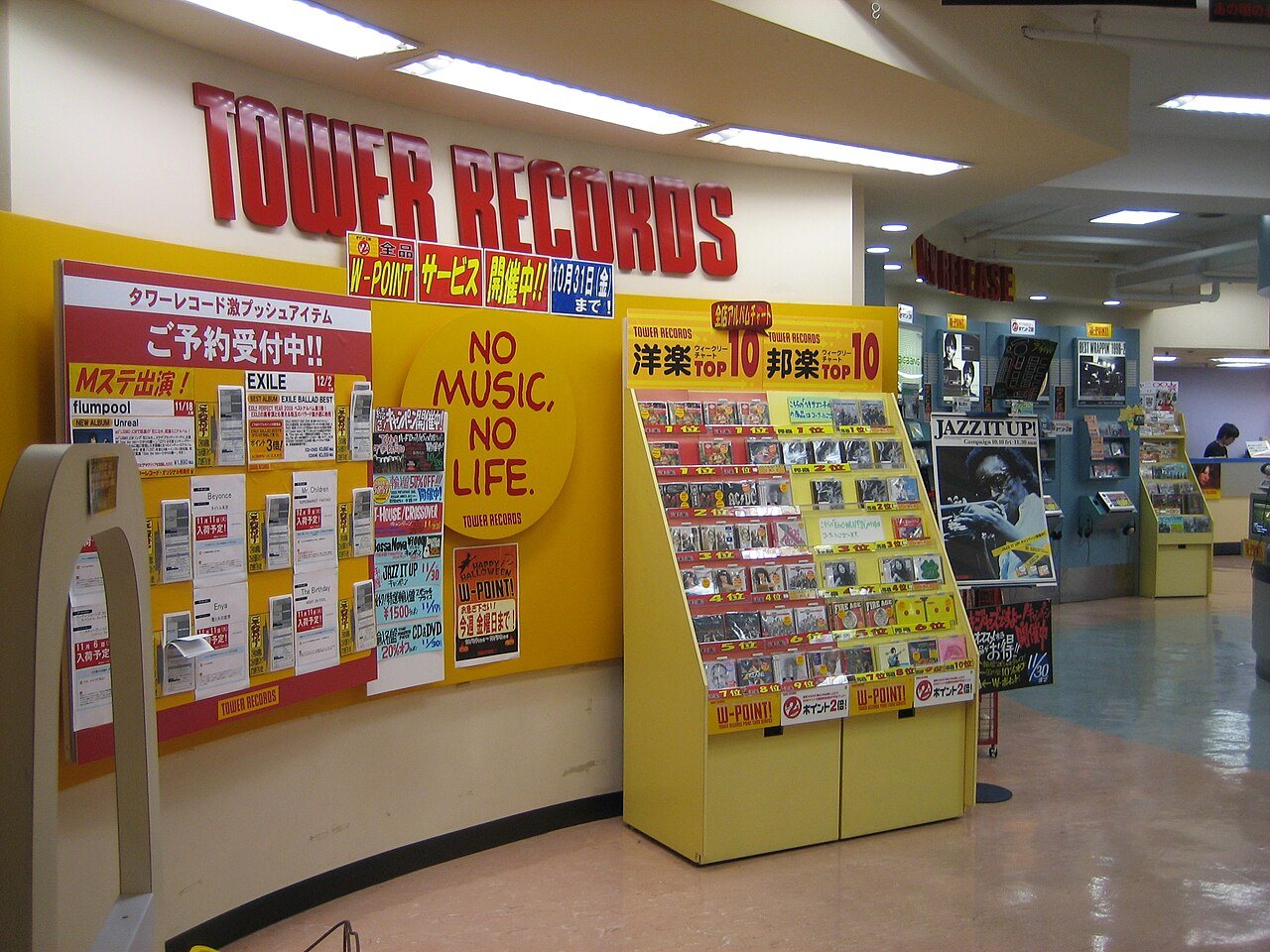
Tower Records stores are still open every day, just not in the country where the chain started. Tower Records Japan became a separate company from the American parent in the early 2000s, which is why it was never part of the 2006 liquidation, and it still runs stores across Japan, including the Shibuya flagship in Tokyo.
Marketplace reported in 2022 on why those stores kept working. Japanese listeners went on buying physical discs long after American listeners stopped, compact discs stayed the dominant format there, and the streaming services that hollowed out American music retail arrived in Japan late.
The gap is easy to underestimate. In the United States the question about Tower Records is which year it closed. In Japan it is which branch to visit, and the chain is treated as a normal part of buying music rather than a memory of it.
That split is also the answer to a question people ask after seeing a photograph of a Tower Records sign taken last week in Tokyo. The stores in Japan were never sold to Great American Group, were never part of the American bankruptcy, and never had to come back, because they never went away.
Frequently Asked Questions
Is Tower Records still in business?
Tower Records is still in business as an online store, which relaunched on November 13, 2020 and sells vinyl, compact discs, cassettes and merchandise. The American retail chain is gone: its 89 remaining stores were liquidated after the October 2006 bankruptcy auction, and no Tower Records store operates in the United States in 2026. Tower Records Japan, a separate company, still runs stores in Japan.
Why did Tower Records go out of business?
Tower Records went out of business because compact disc sales fell away while its debts did not. The Washington Post's 2018 obituary of founder Russ Solomon said the company was felled by digital downloads and competition from discount chains. Tower Records filed for bankruptcy in 2004, filed again in August 2006 with 89 stores in 20 states and about $200 million owed to creditors, and was sold to a liquidation firm at auction that October.
Who owns Tower Records now?
The Tower Records name outlived the chain that made it. The American brand changed hands after the 2006 liquidation and has been run since its November 13, 2020 online relaunch by a management team under chief executive Danny Zeijdel, with no stores and no connection to the original retail operation. Tower Records Japan is owned and run separately, which is why its stores stayed open through and after 2006.