What Barnes & Noble bought out of the wreckage
By the late summer of 2011 the most valuable thing Borders still owned was not a store. It was the name on the sign, the web address and a list of everyone who had ever signed up for a rewards card.
Barnes & Noble bought all three at a bankruptcy auction on September 14, 2011, for $13.9 million. The package covered the Borders trademarks, the Waldenbooks and Brentano's names, the internet domains, and a customer database holding records on 48 million people.
Al Maya International, the franchisee that had been running Borders stores in the Middle East, bought Borders trademarks for five countries at the same auction for $500,000.
The customer list was the part that nearly broke the deal. Privacy advocates told the bankruptcy court that those 48 million people had given their names, email addresses and phone numbers to Borders, not to its largest competitor, and the judge required that each of them be offered a chance to opt out.
So in October 2011 more than 40 million former Borders shoppers opened an email from Barnes & Noble chief executive William Lynch. "First of all let me say Barnes & Noble uniquely appreciates the importance bookstores play within local communities, and we're very sorry your Borders store closed," it began.
Barnes & Noble has controlled borders.com ever since. The Borders online store stopped taking orders on September 27, 2011, and on October 14 the address began pointing at barnesandnoble.com.
Are there any Borders stores left in 2026?
Not in the United States. The last American Borders stores closed in September 2011, and nothing has carried the name in this country since.
The brand kept trading abroad, because Borders Group had sold franchise rights overseas long before it failed. Al Maya Group, a distributor based in the United Arab Emirates, has run Borders-branded book, toy and stationery shops in the Gulf since 2006, and it bought the Middle East rights outright in 2015. Those Gulf stores are the clearest survivor of the brand.
Malaysia had the other one. Berjaya Books ran Borders stores there under a licence bought from the liquidators, and they outlasted the American chain by 12 years before shutting in August 2023.
In the United Kingdom the name went early. Borders UK was sold to a private investment group in 2007 and collapsed into administration in 2009, two years before its former American parent filed for Chapter 11.
Where to find one today. Nothing new carries a Borders logo, so what is left is memorabilia: rewards cards, name badges, tote bags, bookmarks, staff shirts and store signage that walked out of the buildings during the 2011 going-out-of-business sales. Most of it surfaces on Etsy's search page for Borders bookstore items. Price depends almost entirely on how much store branding is on the object, so a sign or a badge costs many times what a used gift card does.
How Kmart stitched Borders and Waldenbooks together
Borders began in 1971 as a used bookstore in Ann Arbor, Michigan, opened by the brothers Tom and Louis Borders. Its real advantage was software. The brothers built an inventory system that predicted which titles a particular town would buy, which let their stores stock tens of thousands of titles instead of the few thousand a mall bookshop carried.
That caught the attention of Kmart, which had bought the mall chain Waldenbooks in 1984 and wanted the superstore end of the market too. Kmart bought Borders in 1992 and ran both chains.
The arrangement lasted three years. Kmart spun the business off in 1995 as Borders Group, listed in New York and headquartered in Ann Arbor, with Waldenbooks as a subsidiary.
It worked for about a decade. Borders Group peaked in 2003 with 1,249 stores trading as Borders and Waldenbooks, a mix of superstores, mall shops, airport outlets and Borders Express units, with locations in the United Kingdom, Singapore and Australia as well.
Why did Borders hand its website to Amazon?
In 2001 Borders decided that running an online bookstore was someone else's job. It signed a deal that turned borders.com into a storefront operated by Amazon, which handled the catalog, the checkout and the customer data.
The arrangement ran until 2008. For seven years, a Borders customer who went looking for a book online was handed to the company that would eventually take the business.
Barnes & Noble spent those same years building its own site, and in 2009 its own e-reader. Amazon had launched the Kindle in 2007. Borders did not open an e-bookstore of its own until July 2010, and that one ran on Kobo rather than anything Borders built.
The rest of the floor plan was a second bet going the same way. Borders superstores devoted large areas to CDs and DVDs, which made sense in 1999 and was dead weight by 2008.
How fast did the collapse actually happen?
Borders lost money every year from 2006 on, and the cutting started at the small end. In January 2010 the company closed about 200 Waldenbooks stores, close to two-thirds of that chain.
Borders Group filed for Chapter 11 bankruptcy protection on February 16, 2011, with 642 stores, and said it would close roughly 200 of them while it hunted for a buyer or a lender willing to fund a turnaround.
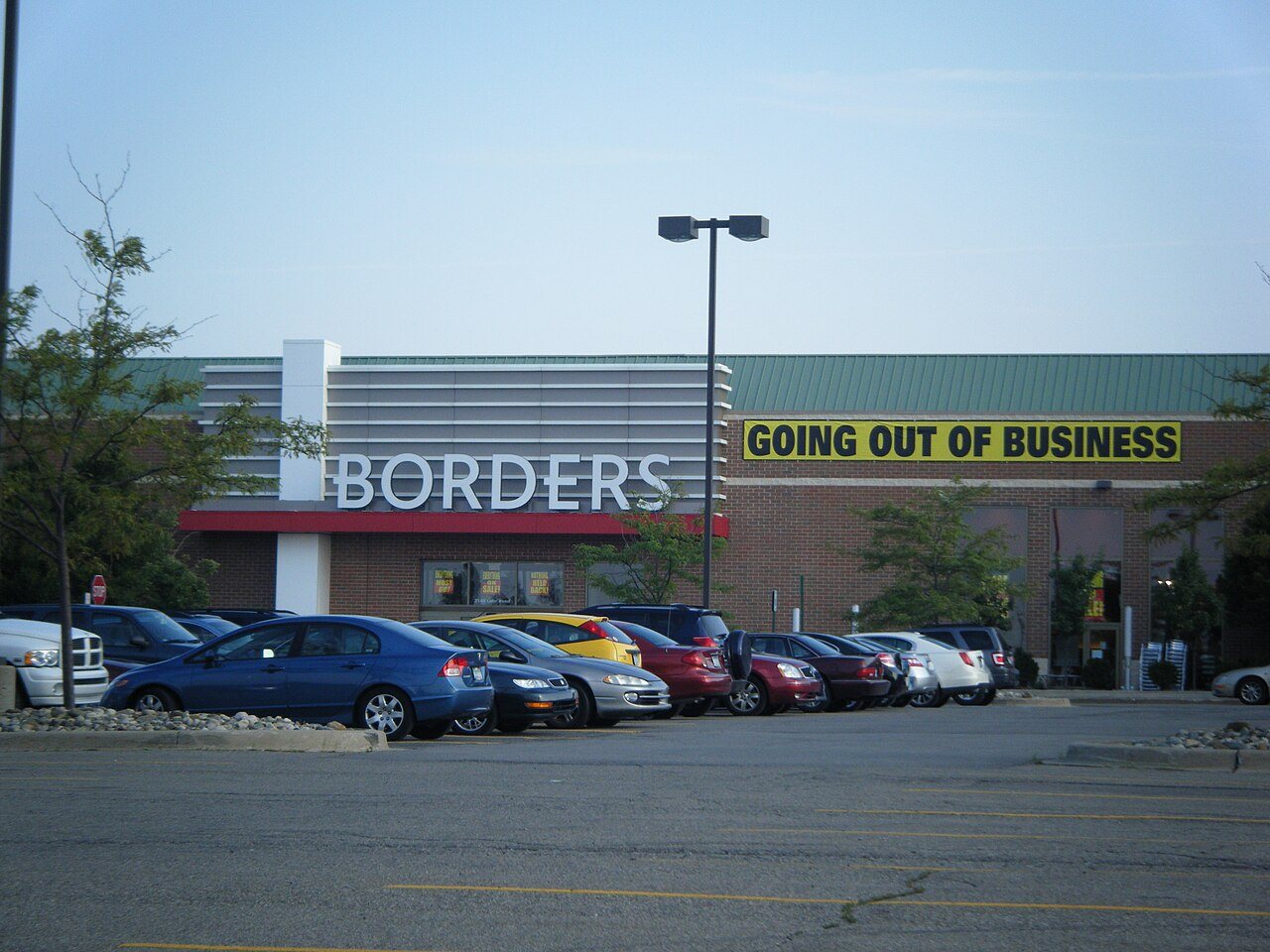
Neither showed up. On July 18, 2011, the company asked the court for permission to liquidate the 399 stores still trading, a decision that ended 10,700 jobs. Going-out-of-business sales began on July 22.
Borders Group president Mike Edwards said in the July 2011 announcement that the company had been fighting headwinds for some time, and that "the rapidly changing book industry, eReader revolution, and turbulent economy, have brought us to where we are now."
The original Ann Arbor shop, known inside the company as Borders No. 1, closed that September. The last American Borders stores shut on September 18, 2011, five months short of the chain's 40th anniversary in its home town.
Was Amazon really what killed Borders?
Amazon takes the blame, and it was a real predator, but the order of events matters. Borders Group was still expanding in 2003, when Amazon was already eight years old. What broke the company was the shape of its own estate.
Borders had signed long leases on very large buildings, sized for a shopper who would buy a book, a CD and a DVD in one trip. When music and video moved to downloads, a big share of that floor space stopped earning and the lease stayed.
The digital side was a decision rather than an accident. Barnes & Noble kept its own website and its own customer list through the 2000s. Borders rented both from its biggest rival until 2008, then took them back after the online book market had already formed.
Waldenbooks made the arithmetic worse. Mall traffic fell through the 2000s and Borders Group owned hundreds of small mall stores it could not fix, which is why 200 of them went in a single month in 2010.
None of that was Amazon's doing. It only meant that when the book business moved, Borders had nothing left to move with.
Frequently Asked Questions
Is Borders still around in 2026?
Borders is not around in the United States. The chain filed for Chapter 11 in February 2011, liquidated the last 399 stores that summer and closed its final American locations on September 18, 2011. Borders-branded shops still trade in the Gulf under Al Maya Group, which has held the Middle East rights to the name since 2015.
Who owns the Borders name now?
Barnes & Noble has owned the Borders name in the United States since 2011. It paid $13.9 million at a September 2011 bankruptcy auction for the Borders, Waldenbooks and Brentano's trademarks, the internet domains and a database of 48 million Borders customers. Al Maya International bought the Borders trademarks for five other countries at the same auction for $500,000.
What happened to Waldenbooks?
Waldenbooks was the mall bookstore chain Kmart bought in 1984 and brought under Borders Group in 1992. Borders closed about 200 Waldenbooks stores in January 2010, and the rest went in the liquidation that ended in September 2011. The Waldenbooks trademark has belonged to Barnes & Noble since that year.